
252 GB
7.1 TB/s reference bandwidth
Blackwell Ultra GPU memory for high-throughput local tensor access. Resident weights, activations and KV cache all compete for capacity.
ZXO / FLAGSHIP AI DESIGN STUDY
A stronger presence.
A considered architecture.
Racing red. Graphite. An unmistakable ZXO signature. A full-size liquid-cooled workstation concept for the NVIDIA GB300 Grace Blackwell Ultra Desktop Superchip.
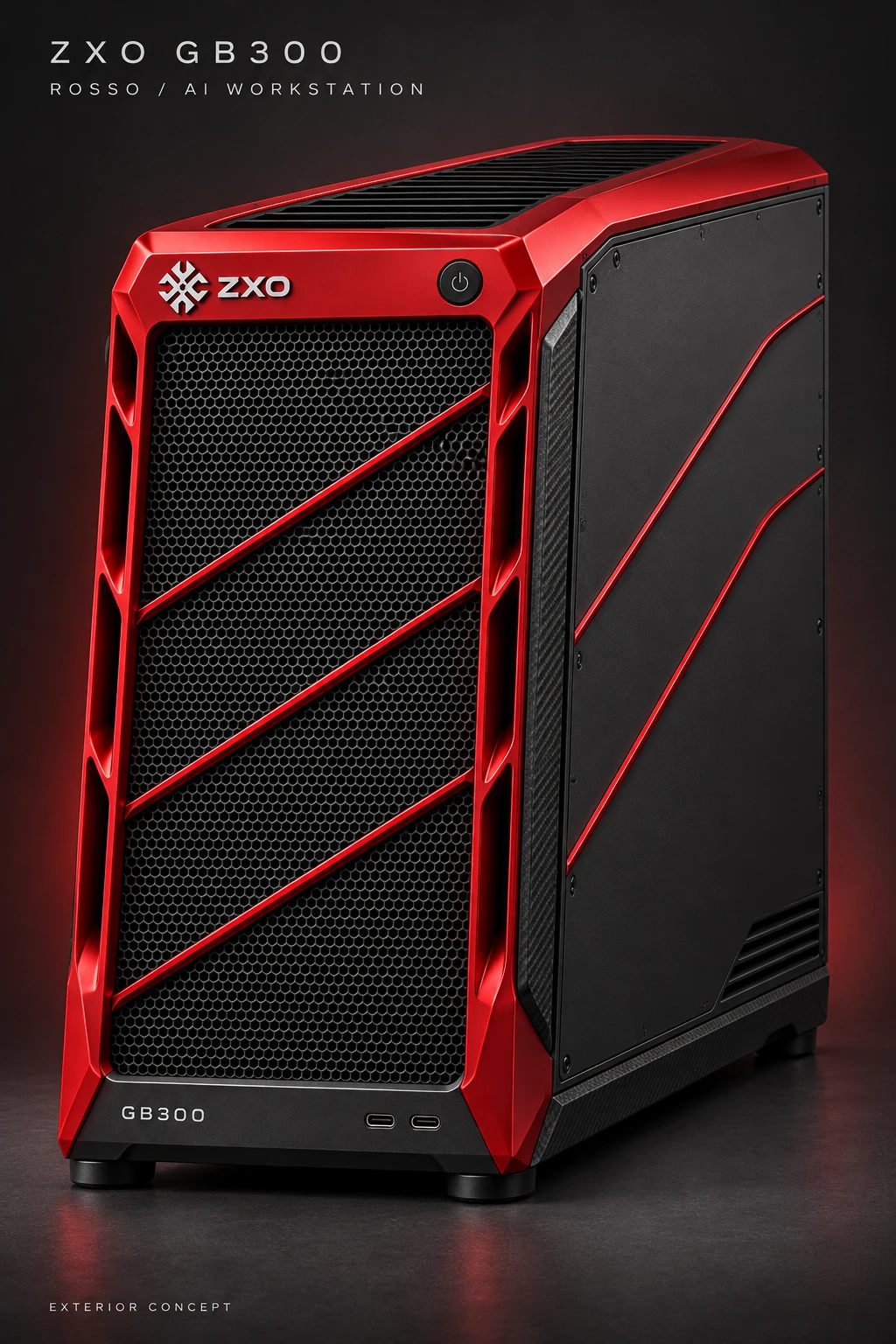
Design concept · Engineering validation pending. NVIDIA figures describe the reference platform. The proposed ZXO enclosure, cooling loop and final configuration have not been validated as a complete system.
ONE PLATFORM.
MORE ROOM TO EXPLORE.
01 / A PURPOSEFUL BASELINE
Start with one GB300 Desktop Superchip and a substantial local storage target. The table separates NVIDIA reference capabilities from the ZXO design choices that still require OEM and complete-system validation.
Swipe to view all columns
| Component | Reference platform | ZXO ROSSO development target |
|---|---|---|
| Core platform | NVIDIA GB300 Grace Blackwell Ultra Desktop Superchip | One Desktop Superchip; OEM platform selection and integration pending. |
| CPU | 1 × Grace CPU; 72 Arm Neoverse V2 cores | Use the reference CPU configuration. Validate Arm64 application and container support. |
| Primary GPU | 1 × NVIDIA Blackwell Ultra GPU | Dedicated core AI accelerator. No additional graphics card is shown in the interior concept. |
| GPU memory | 252 GB HBM3e ECC; 7.1 TB/s bandwidth | Keep bandwidth-sensitive tensors in GPU-local memory where the software permits. |
| CPU memory | 496 GB LPDDR5X ECC; 396 GB/s bandwidth | Host memory and coherently accessible capacity; distinct from GPU-local HBM. |
| Coherent link | NVLink-C2C; 900 GB/s reference bandwidth | 748 GB total across CPU and GPU memory. Actual placement and access depend on the software. |
| Local storage | Four M.2 NVMe positions; generation and lane mapping depend on the selected OEM system | 4 × 8 TB NVMe = 32 TB raw. Confirm supported drives, physical fit, slot mapping, cooling and firmware before specifying a BOM. |
| Storage protection | Storage layout depends on the OEM system and software | Define OS, working data, checkpoints and backup separately. Usable capacity depends on formatting and any redundancy. |
| High-speed networking | ConnectX-8; 2 × QSFP112, up to 400 GbE per port; up to 800 Gb/s aggregate | Specify compatible Ethernet switches, cables/transceivers and network settings for the deployment. |
| LAN & management | 1 × 10 GbE RJ45 + 1 × 1 GbE management RJ45 | Plan separate workload and management networks. Final rear I/O follows the selected OEM board. |
| Local display | Primary host display uses a PCIe add-in GPU; BMC Mini DisplayPort is for management-console access | Core AI is a network/headless target. For a local accelerated desktop, specify an OEM-supported add-in graphics option. |
| Power planning | 1600 W reference system; 20 A circuit requirement | Confirm the complete system's PSU, input voltage, cable, connector and site circuit with the OEM. This is not a measured ZXO power rating. |
| Cooling | OEM-specific implementation | Proposed closed liquid loop with parallel CPU/GPU branches, front/top radiator zones and rear case exhaust. Thermal qualification is pending. |
| Software | Ubuntu with NVIDIA AI Developer Tools; Arm64 platform | Validate OS image, driver/CUDA versions, container images, frameworks and application licensing as one supported stack. |
| Product status | NVIDIA reference specifications describe the platform | Exterior and internal-layout concept. A final shipping configuration, price and availability have not been announced. |
Reference basis: NVIDIA platform specifications and DGX Station documentation [1–3]. The enclosure renderings illustrate a design direction and do not establish motherboard dimensions, exact port placement or production component fit.
OPTIONAL / VISUALIZATION EXPANSION
A proposed visualization option is 1 × NVIDIA RTX PRO 6000 Blackwell Workstation Edition, with 96 GB GDDR7 ECC and a 600 W maximum GPU power specification. It is an optional target, rather than part of the Core AI baseline or the rendered internal layout. A local accelerated desktop requires an OEM-supported graphics configuration, which need not be this particular card.
Its 96 GB remains separate graphics memory. It does not turn the 748 GB coherent platform into an 844 GB memory pool. Applications, Arm64 drivers, PCIe support, physical clearance and OEM whole-system power and cooling support must be confirmed.
The reference platform shares power between the GB300 module and an optional RTX card. Supported power caps and OEM policy determine the operating combination. The 600 W card maximum does not establish simultaneous 1600 W plus 600 W operation.
Graphics [4] · Memory separation [6] · Power sharing [7] ↗02 / UNDERSTAND THE ARCHITECTURE
Coherence lets compatible software work across CPU and GPU memory. The total capacity is large; the two memory types and their access paths still have different bandwidth and latency characteristics.
7.1 TB/s reference bandwidth
Blackwell Ultra GPU memory for high-throughput local tensor access. Resident weights, activations and KV cache all compete for capacity.
900 GB/s
reference link
396 GB/s reference bandwidth
Grace CPU memory provides host capacity and coherent access for supported workflows. Remote access does not have GPU-local HBM bandwidth.
Capacity is the sum. Performance depends on where the data lives and how the workload accesses it.
Raw model weights are only one allocation. Leave capacity for the operating system, runtime, KV cache, activations, batching and working data. Quantization and offload behavior are model- and framework-specific.
A model can fit within the coherent capacity while its speed changes with CPU-memory traffic, quantization kernels and context length. Validate time to first token and sustained decode rate using the intended configuration.
Memory capacity, bandwidth, NVLink-C2C and coherency: NVIDIA references [1, 2, 6]. No ZXO throughput or model-size guarantee is implied.
03 / MATCH THE WORKLOAD
NVIDIA specifies up to 20 PFLOPS of FP4 Tensor Core performance with sparsity, or 15 PFLOPS without sparsity. These are precision-specific compute peaks, not measured application results for ZXO ROSSO.
Evaluate the exact model revision, quantization, context, batch size and concurrency. Measure prompt processing and token generation separately; a peak FP4 figure does not establish tokens per second or latency.
Parameter-efficient tuning, evaluation and data preparation have different memory requirements. Gradients, optimizer state and activations can dominate training memory. Inference fit does not establish an equivalent training limit.
Check framework builds, container architecture, CUDA extensions, custom kernels and application licensing. An x86 Windows application does not automatically run on the Grace Arm64 platform.
NETWORKING
The reference ConnectX-8 design provides two 400 GbE ports and up to 800 Gb/s aggregate Ethernet bandwidth. A single transfer is not automatically 800 Gb/s; link configuration, switches, cables, storage and application protocols determine achieved throughput.
Multiple connected workstations do not automatically become one larger coherent-memory system. Distributed applications need a supported software and network design.
SOFTWARE
Start with the OEM-supported Ubuntu image and NVIDIA AI Developer Tools. Record firmware, driver, CUDA, container and framework versions alongside the workload.
Confirm optional graphics support with the platform OEM and application vendor. A supported combination must include physical integration, PCIe behavior, drivers and power management.
Compute and connectivity references [1–3]; optional graphics [4]. Real application performance remains to be measured on a validated complete system.
04 / THE PROPOSED THERMAL PATH
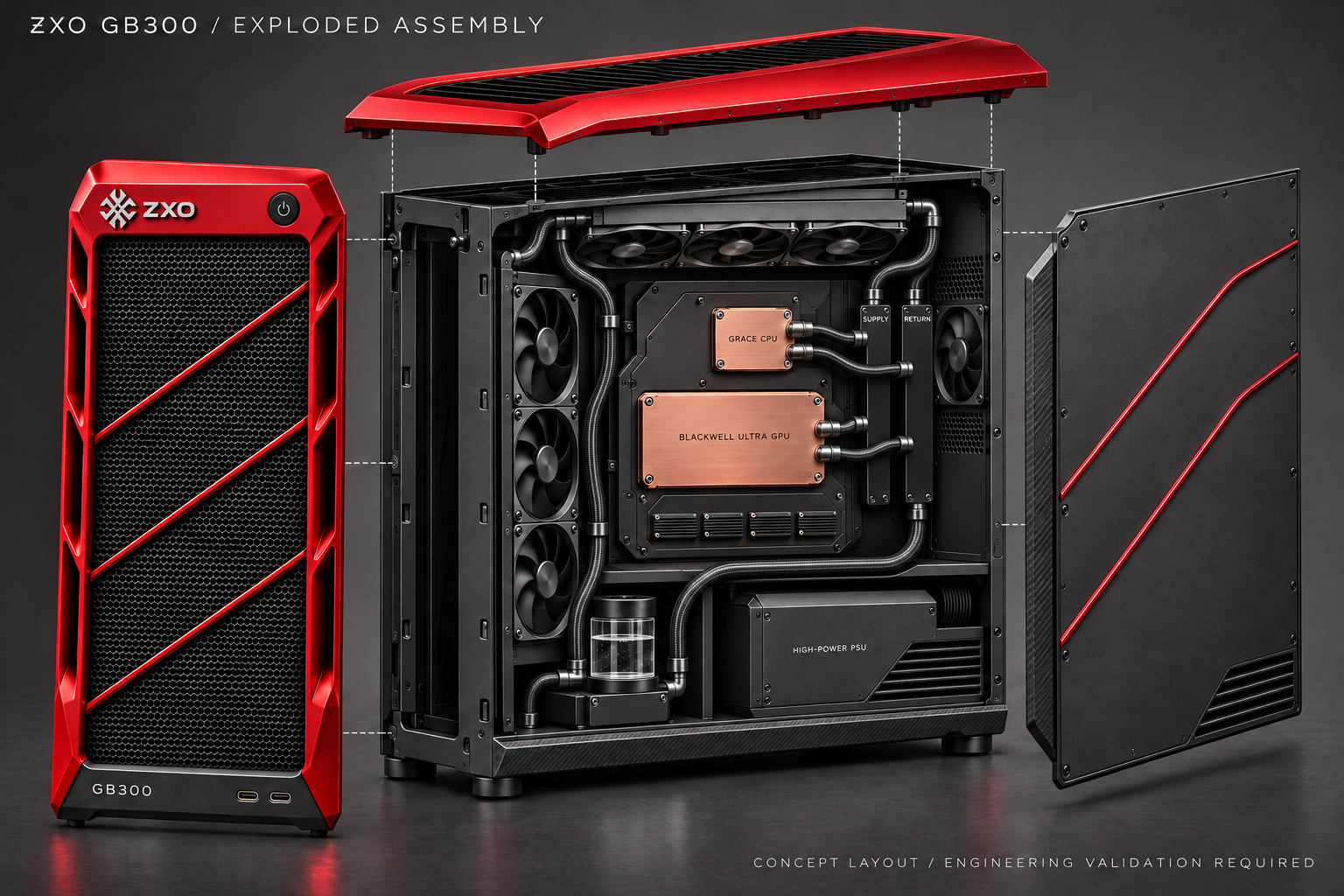
An internal layout study built around separate CPU and GPU cold plates. Supply and return headers create independent branches, with radiator and case airflow zones expressed in the enclosure.
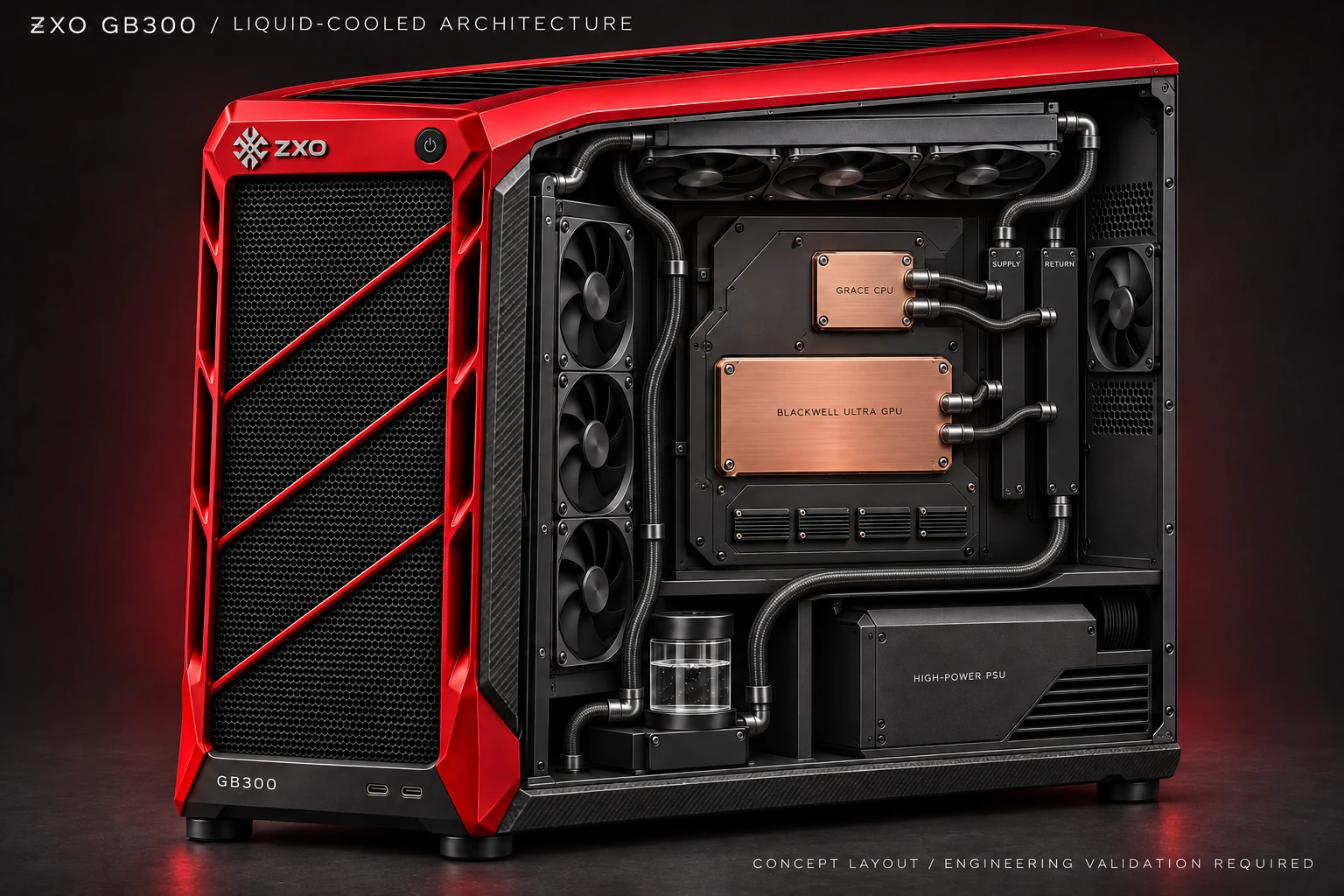
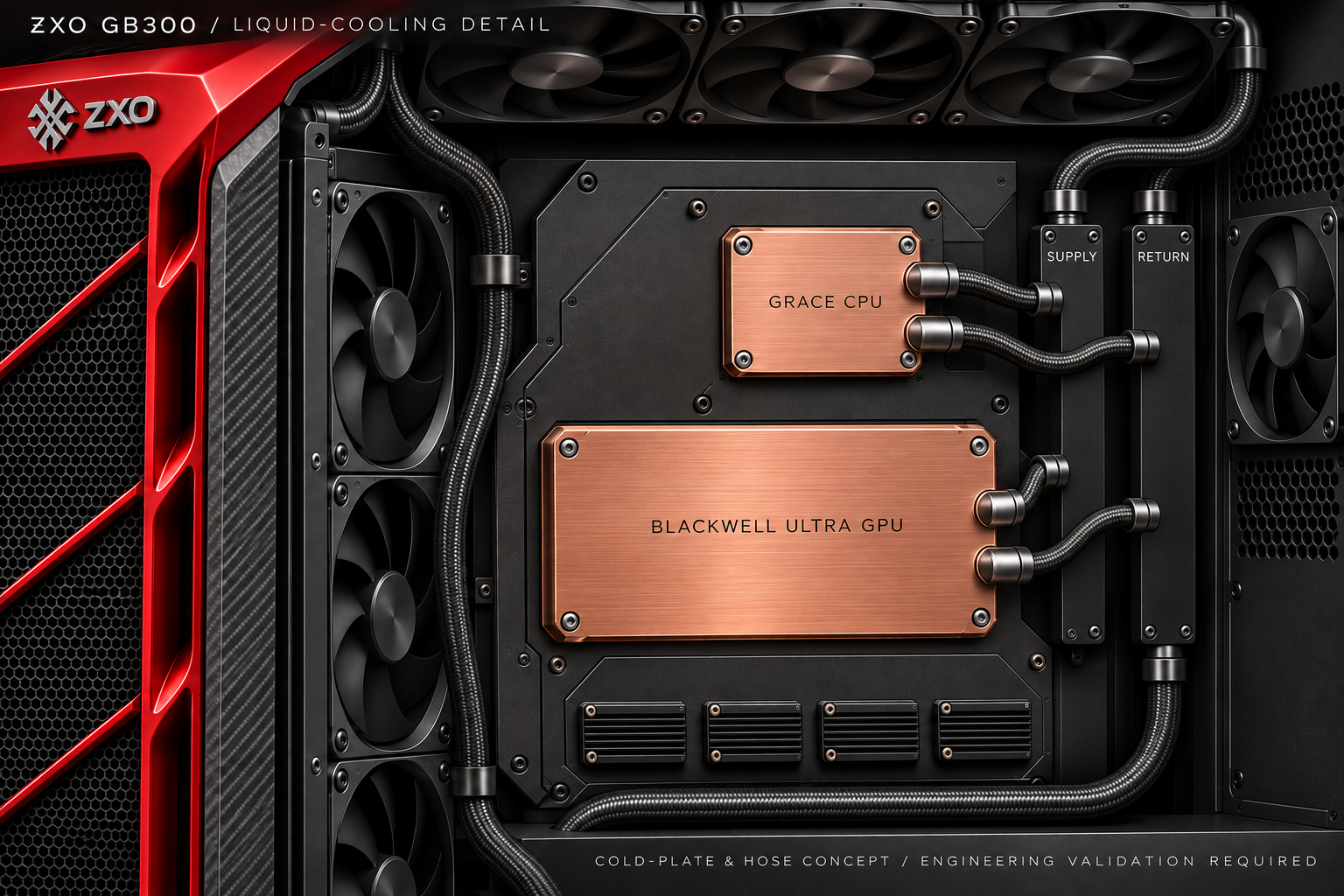
One Grace CPU, one Blackwell Ultra GPU. The interior is illustrative; board layout, tubing, fittings and mounting remain engineering targets.
The proposed supply header feeds the CPU and GPU cold plates on parallel branches. Both return branches join the return header and pump/reservoir loop. Branch balance, flow rate, coolant and pressure drop require validation.
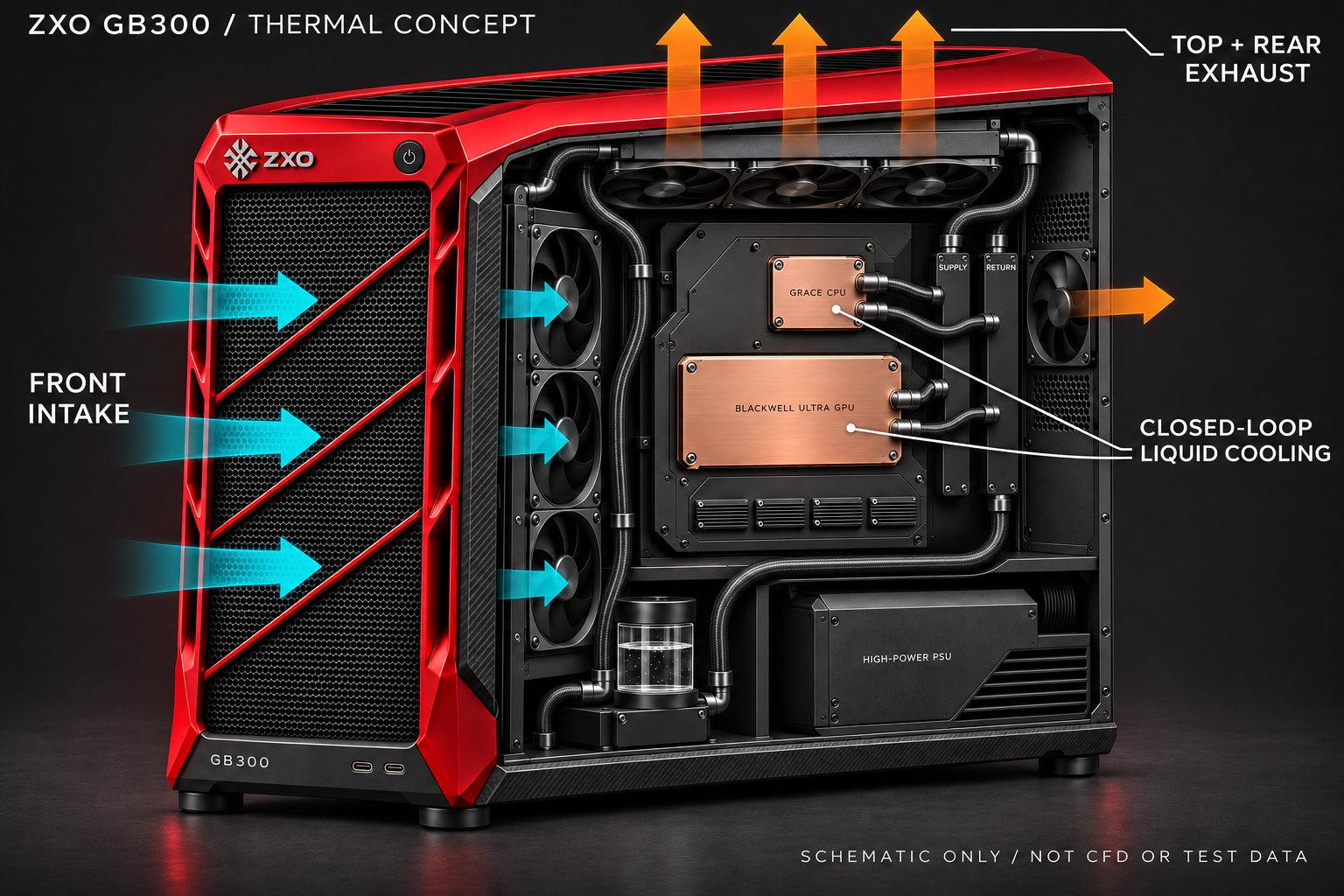
The concept shows front and roof radiator/fan assemblies. Core thickness, fan curves, radiator capacity and chassis pressure must be selected around the actual OEM thermal load; the rendering does not prove cooling capacity.
A removable service panel and lower pump/reservoir zone express the service intent. Final drain/fill access, leak testing, electrical isolation, filters and maintenance clearances need a complete mechanical design.
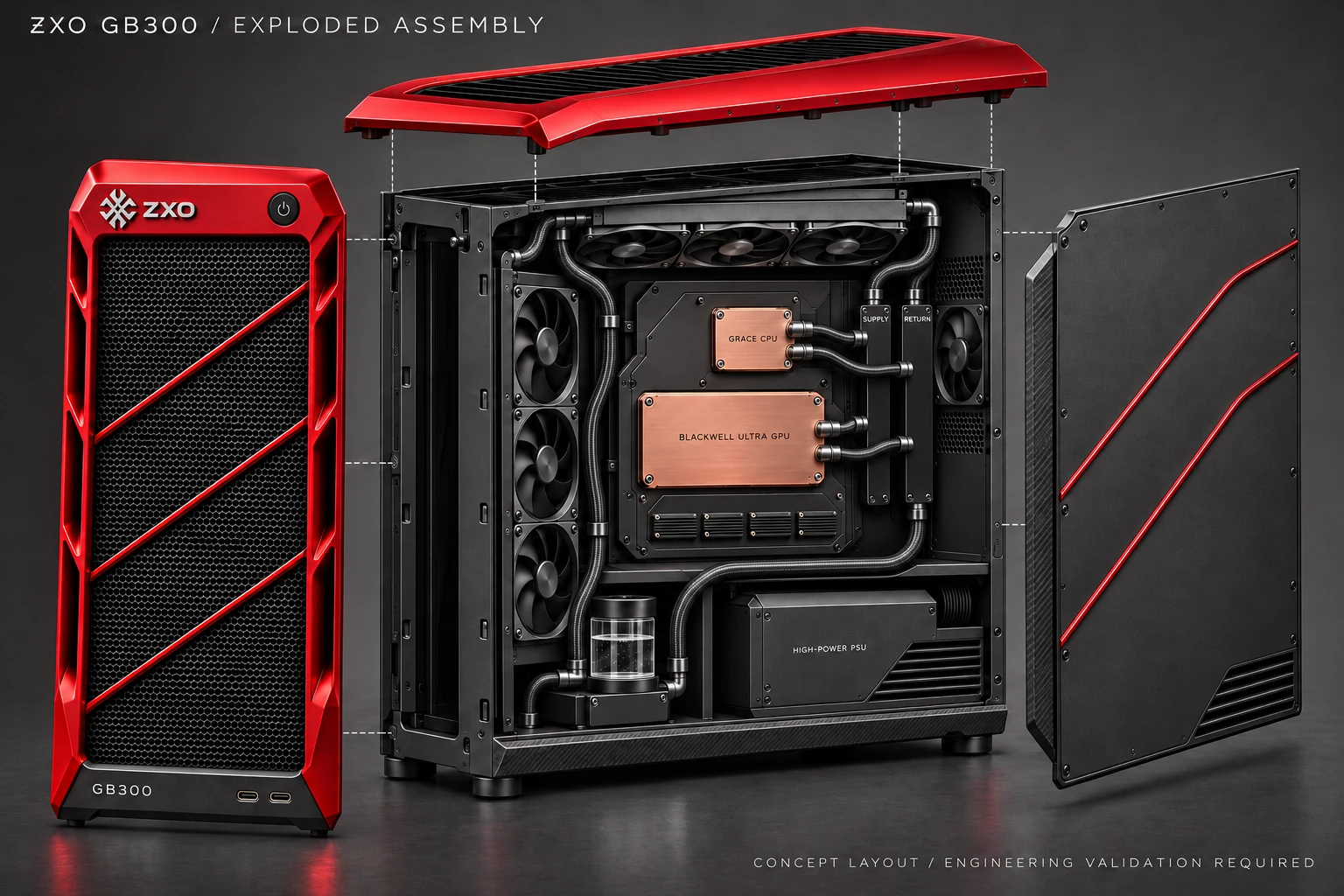
Illustrative assembly and service relationships. No production tolerances or exact component fit are established.
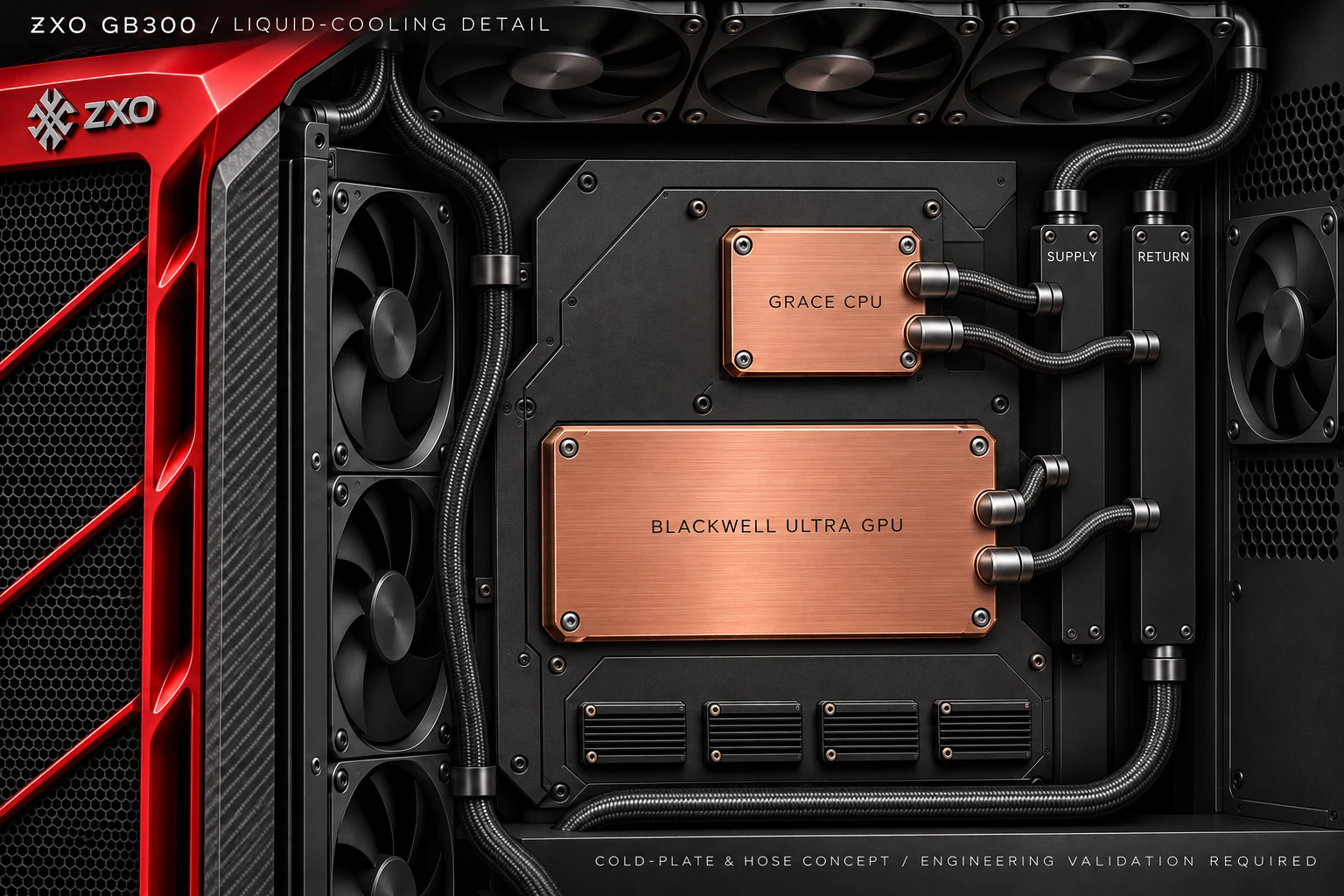
Separate supply and return headers. Connections, seals, flow balance and coolant compatibility require engineering qualification.
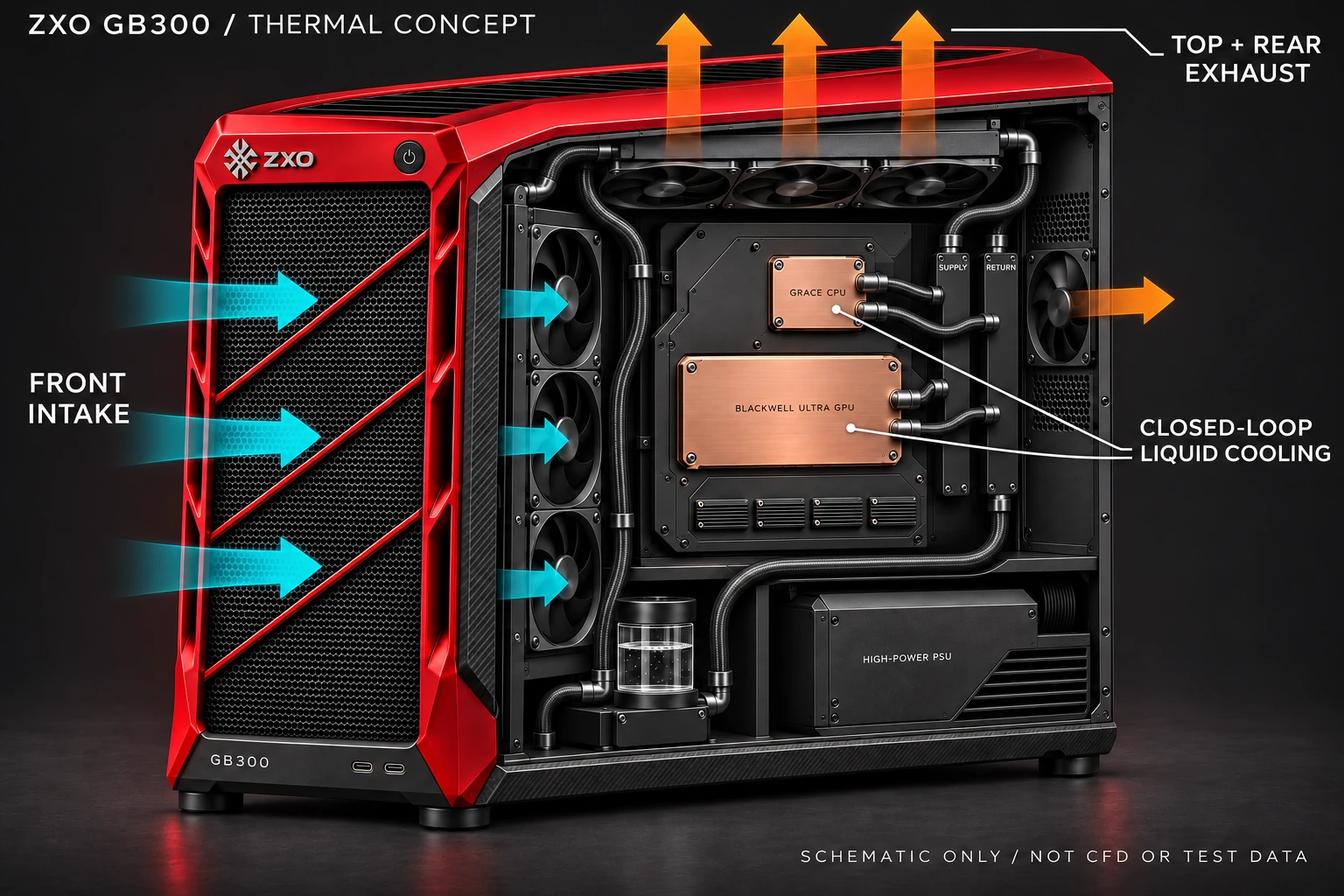
Cyan intake and orange exhaust show intended direction only. This is not CFD, a temperature map or measured test data.
THE NEXT ENGINEERING STEP
No measured temperatures, acoustic levels, sustained clocks or application benchmarks are claimed for this concept.
A commercial OEM GB300 Desktop implementation demonstrates closed-loop cooling as a platform approach [5]. It does not validate the ZXO loop, fan layout or performance shown here.
05 / THE COMPLETE VISUAL STUDY
Explore the tall-tower silhouette, material details, proposed internal architecture and workspace scene. Select any image to enlarge it or download the original.
Download the complete image set · ZIP ↗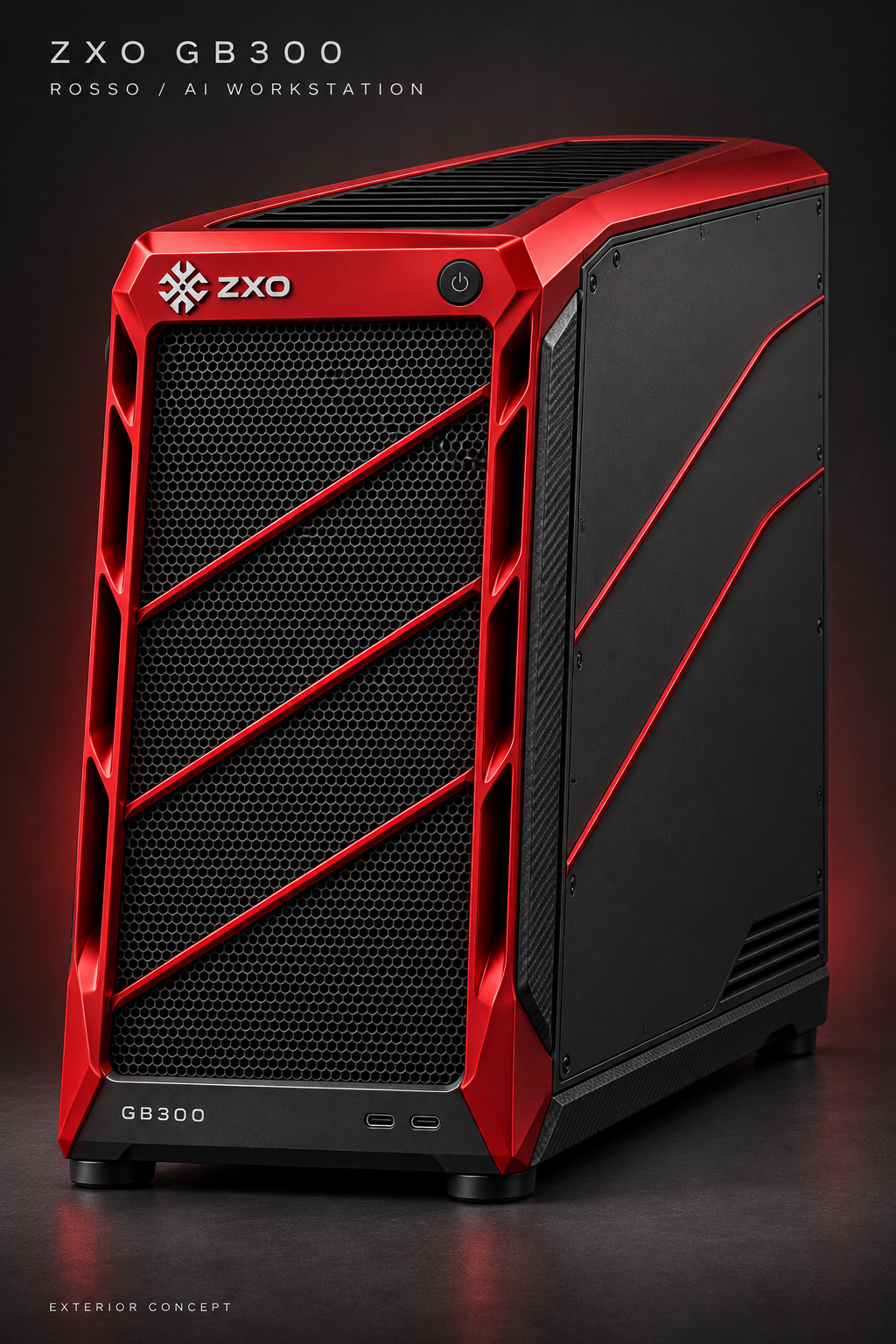
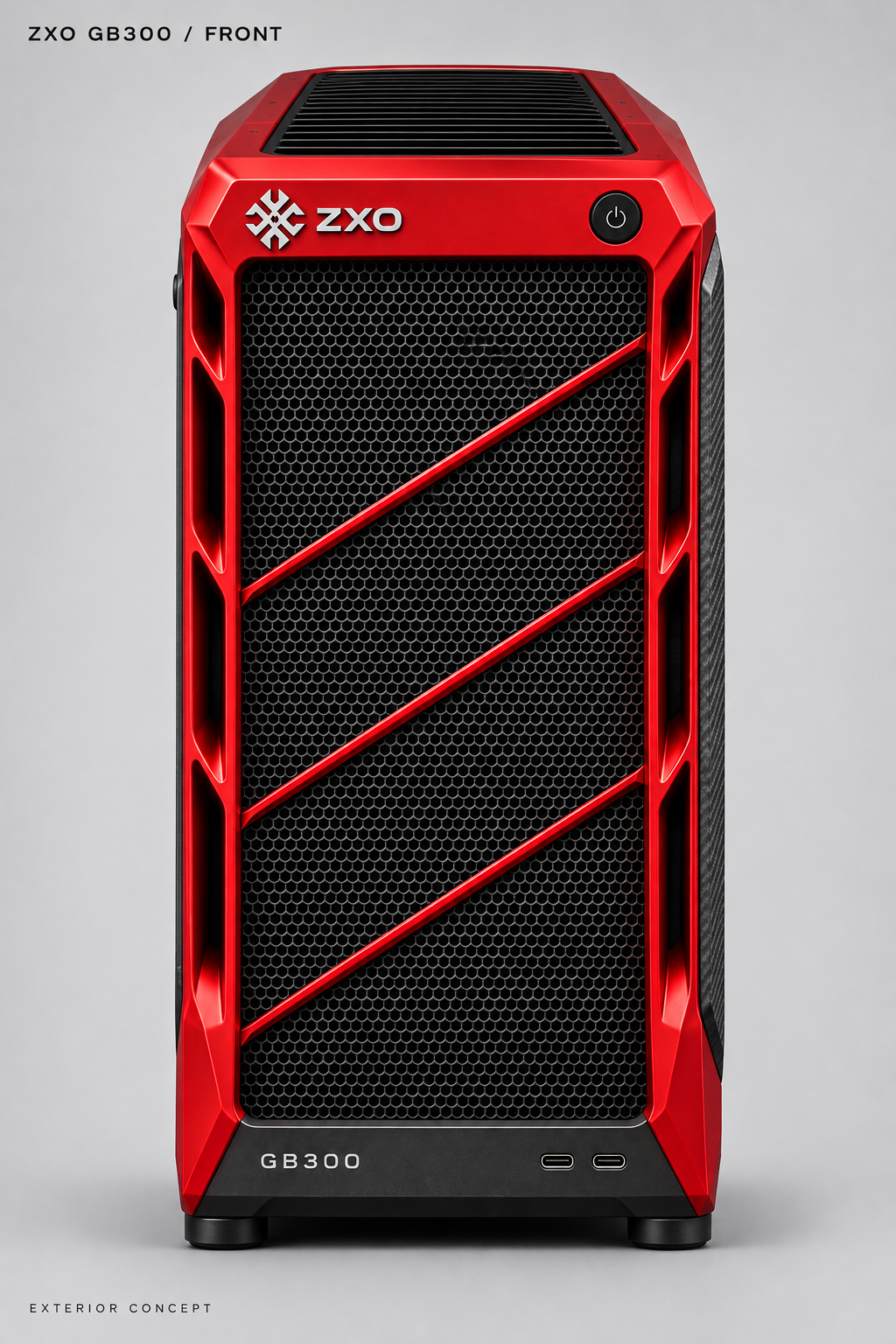
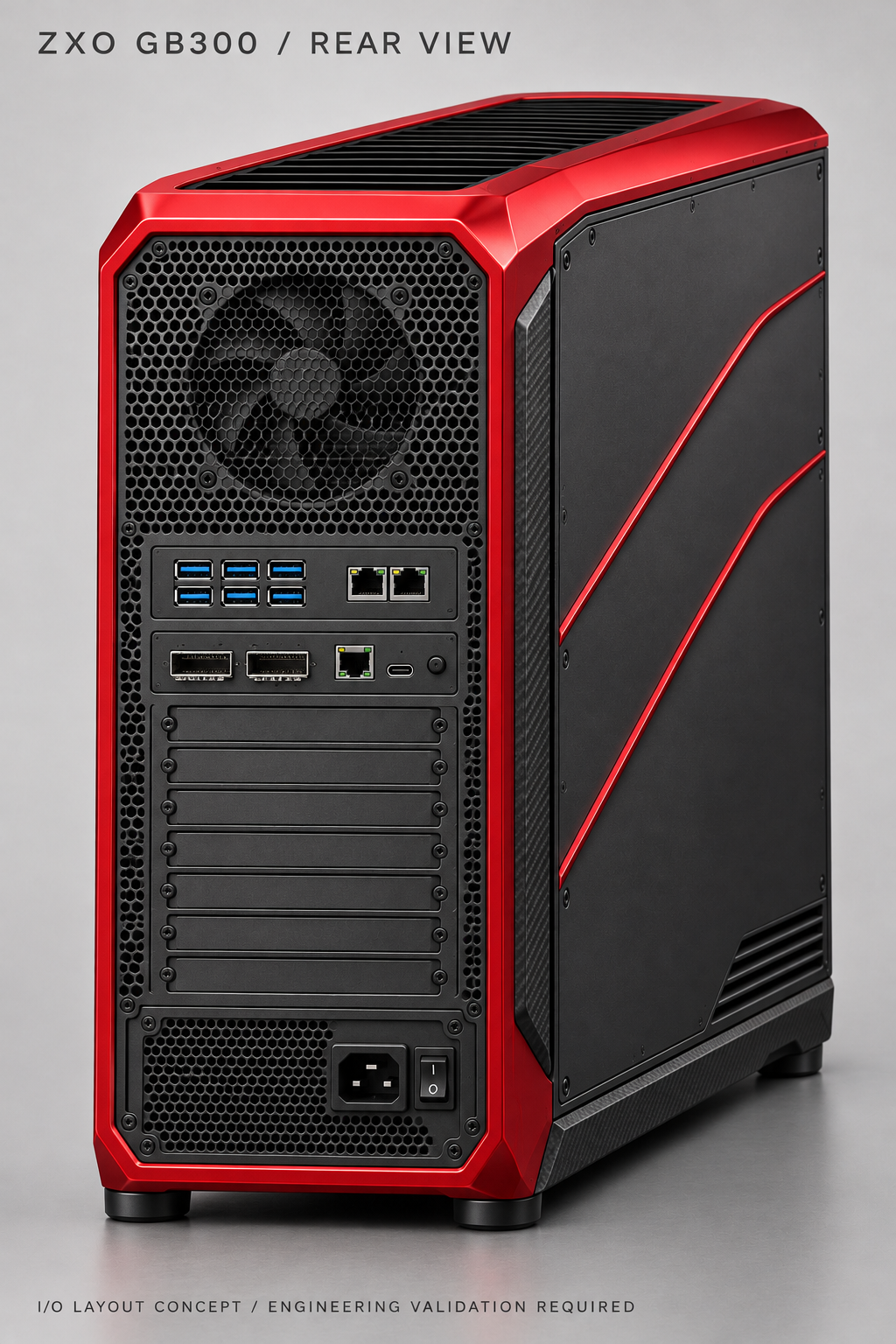
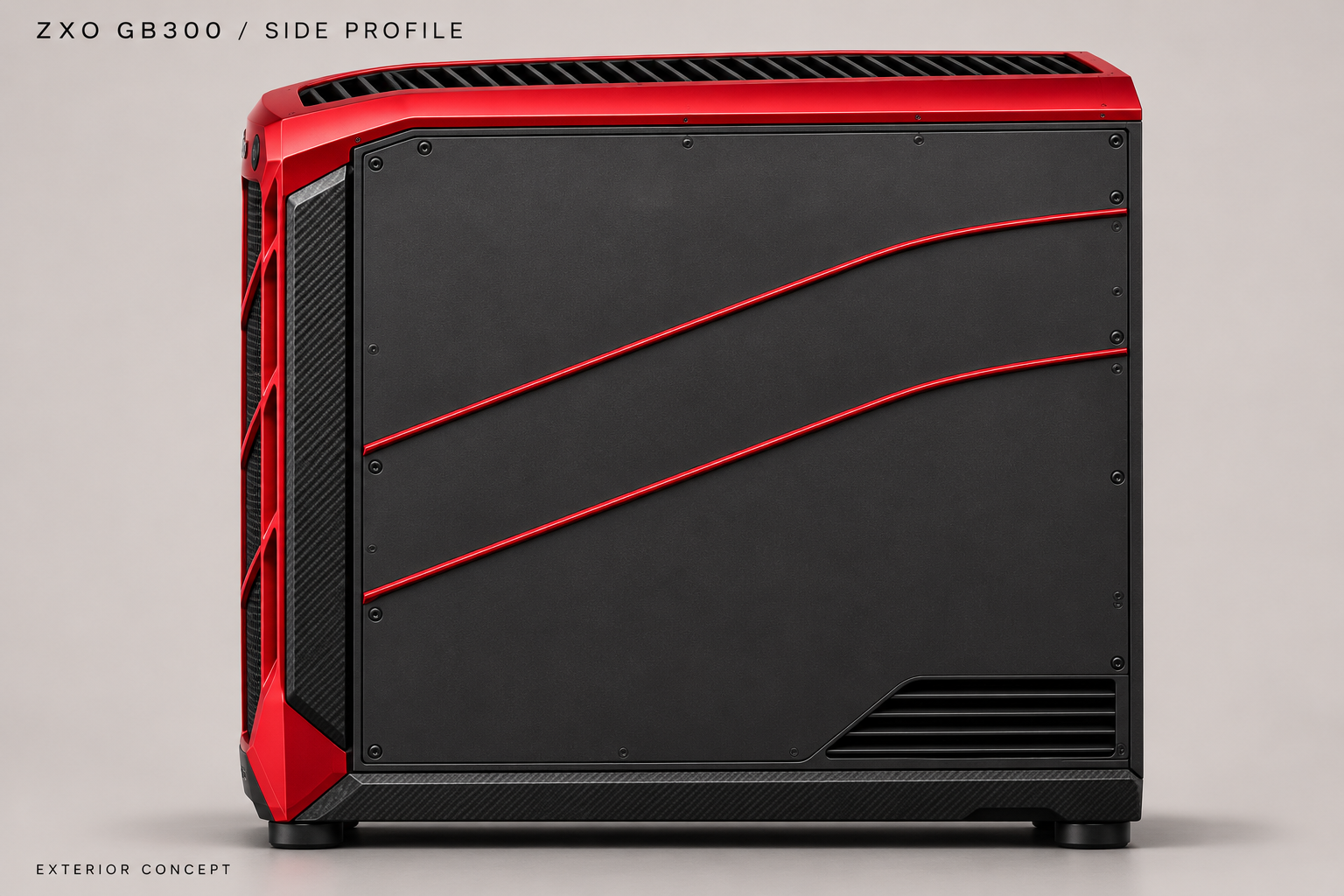
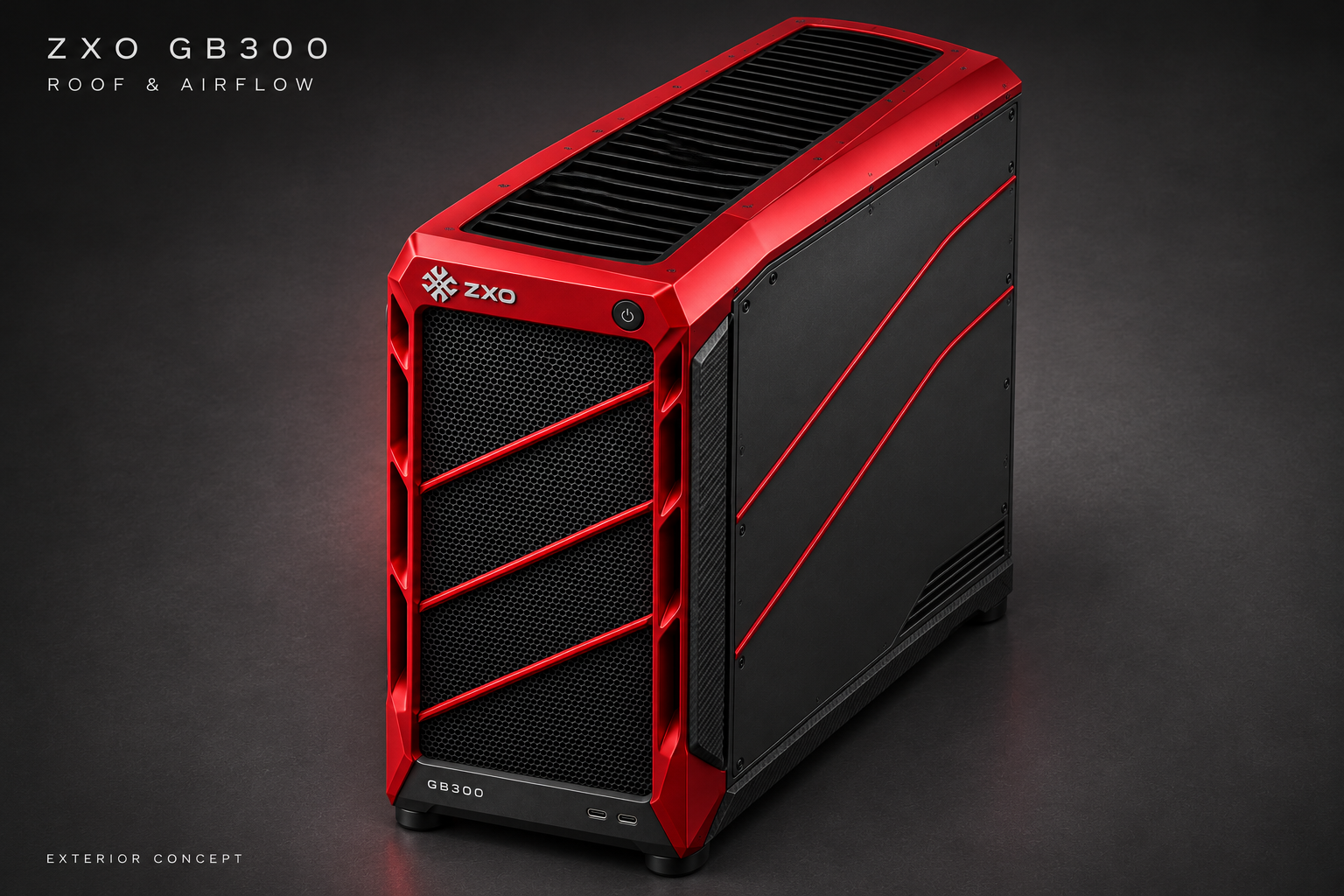
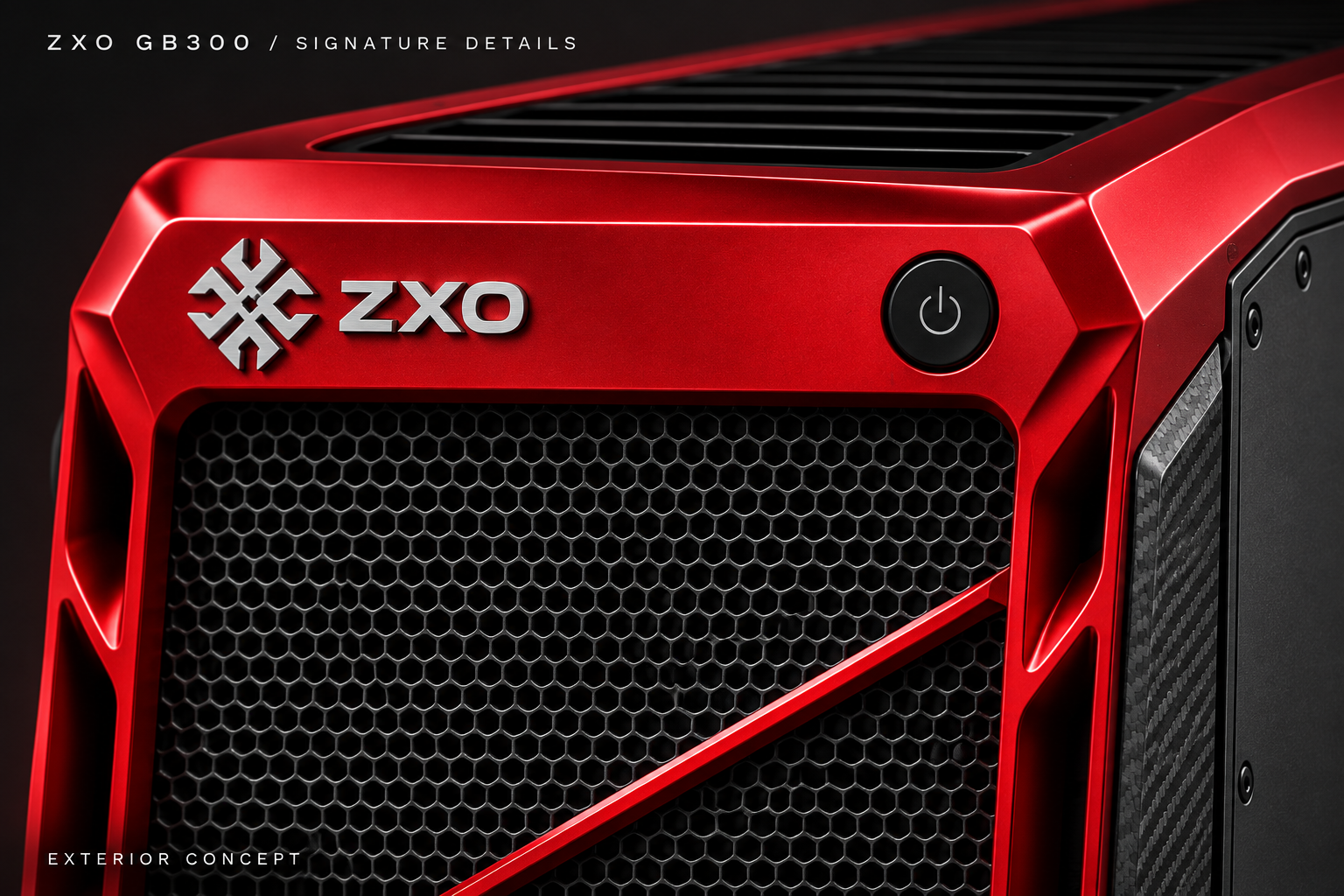
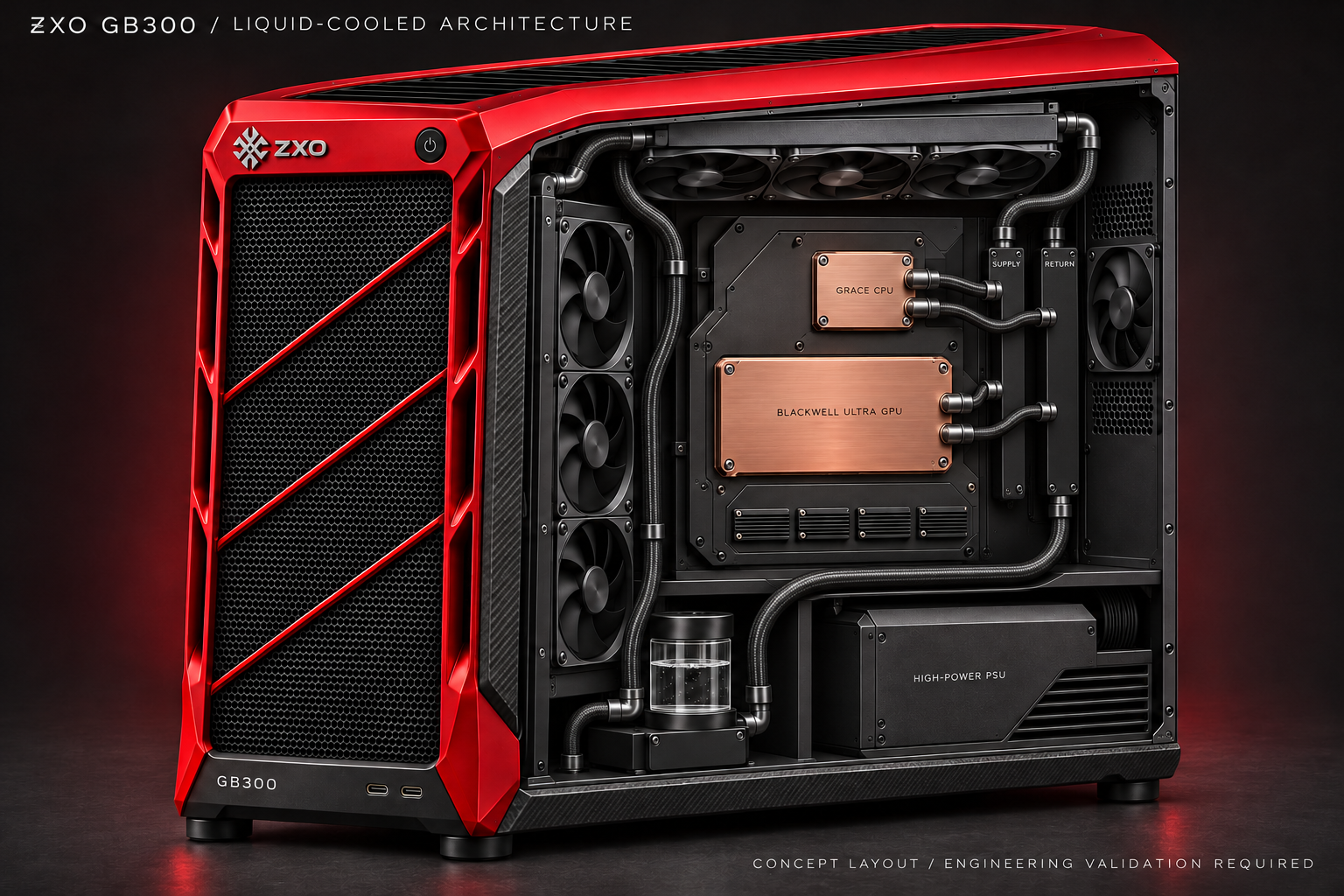
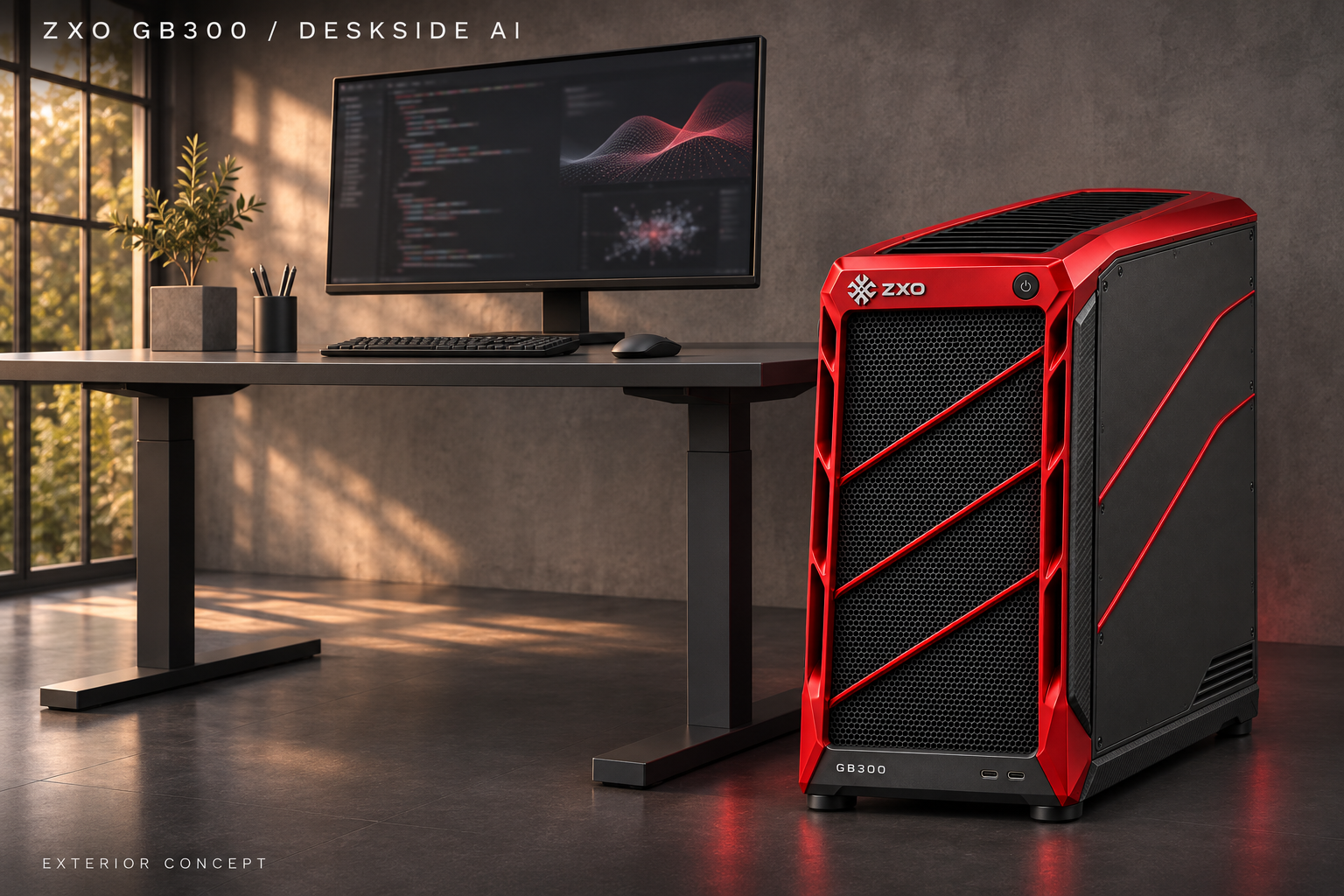
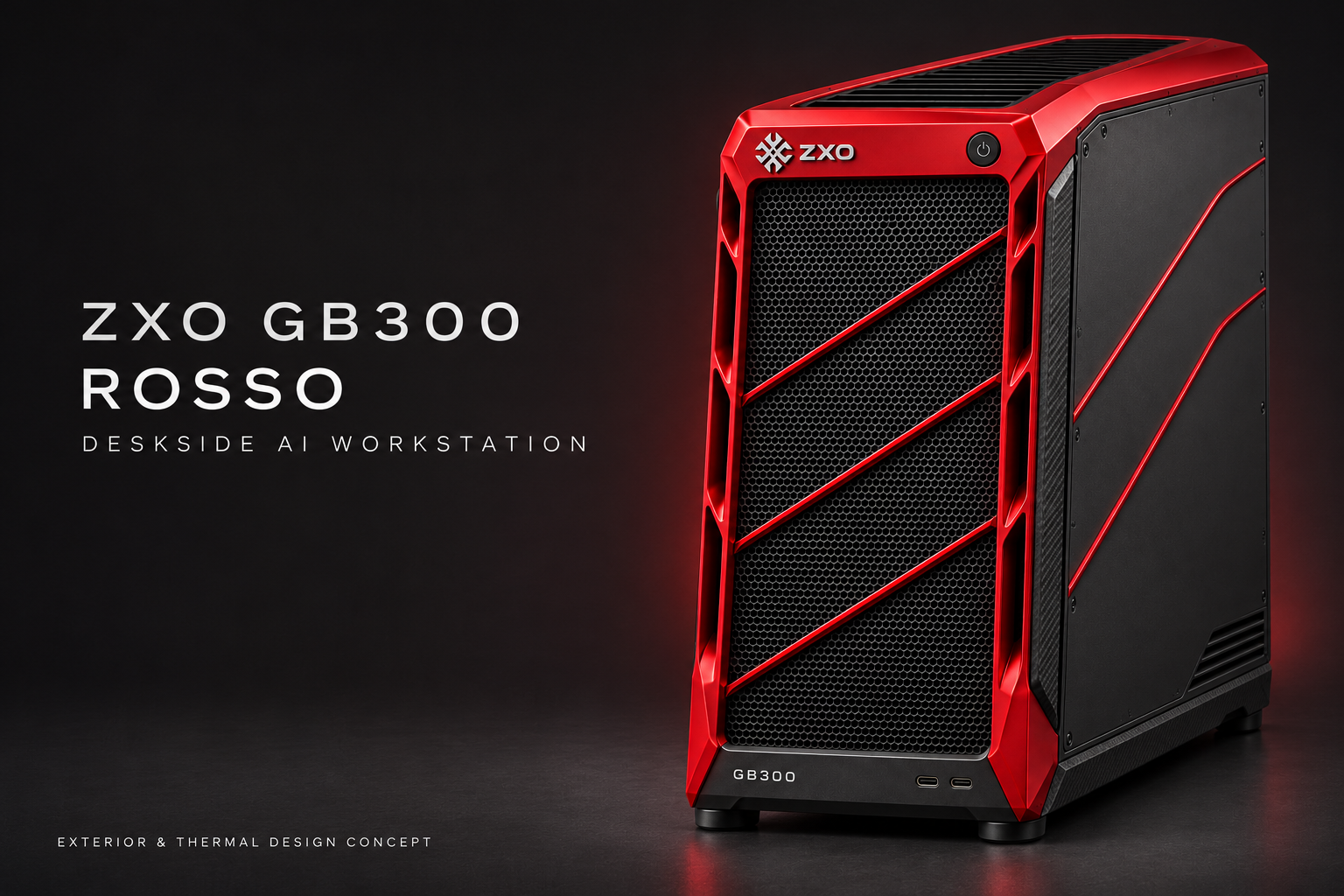
Twelve AI-generated design visualizations. Internal components, connectors and dimensions are illustrative. The ZIP contains original PNGs and design notes.
SOURCE NOTES / REVIEWED NOVEMBER 5, 2026
GB300 Desktop CPU/GPU, memory tiers, bandwidth, compute peaks, networking and reference power.
Desktop Superchip architecture, coherent memory and platform development context.
Ubuntu/Arm64, AI software, add-in graphics for the host display and reference storage-position details. Confirm final slot generation and lane mapping with the OEM.
Optional graphics reference: 96 GB GDDR7 ECC and 600 W maximum GPU power; OEM integration remains conditional.
Official OEM GB300 Desktop implementation and closed-loop liquid-cooling context. This is a separate product from the ZXO design study.
Grace–Blackwell coherent-memory behavior and the separate memory of an optional PCIe graphics card.
Power allocation between the main GB300 module and optional RTX graphics; supported limits depend on platform policy.
START WITH YOUR WORKLOAD
Share the models, context lengths, concurrency, applications, storage and installation power available. Together, these requirements define the next configuration and validation step.