Let function shape the silhouette.
Substantial ventilation areas are intended to support a practical air path. Intake resistance, component clearances and cooling controls will be assessed as one system.
ZXO GB300 / FLAGSHIP AI WORKSTATION CONCEPT
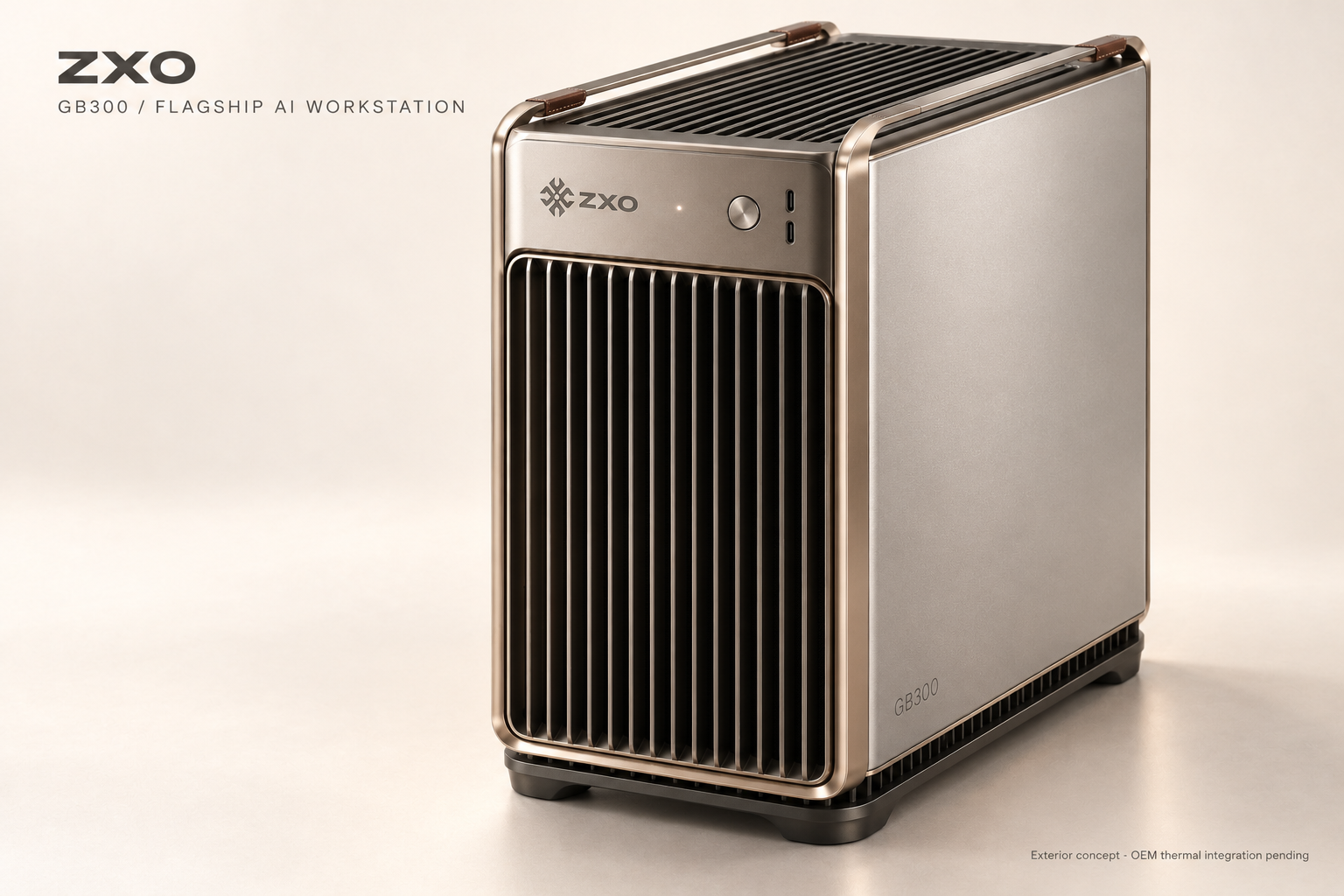
A proposed flagship for demanding local AI, with an NVIDIA GB300 Grace Blackwell Ultra Desktop Superchip platform at its core. A substantial metal enclosure gives powerful computing an equally purposeful place at your desk.
Plan your GB300 configurationExterior concept and proposed flagship targets.
OEM validation pending. Availability and pricing not announced.
THE FLAGSHIP DEVELOPMENT BRIEF
ZXO GB300 is being considered as a platform for larger local AI projects, supported visualization workflows and substantial fast storage. The development brief pairs the GB300 desktop architecture with an optional professional graphics target, while keeping their different memory and power requirements explicit.
01 / FORM FOLLOWS THE AIR
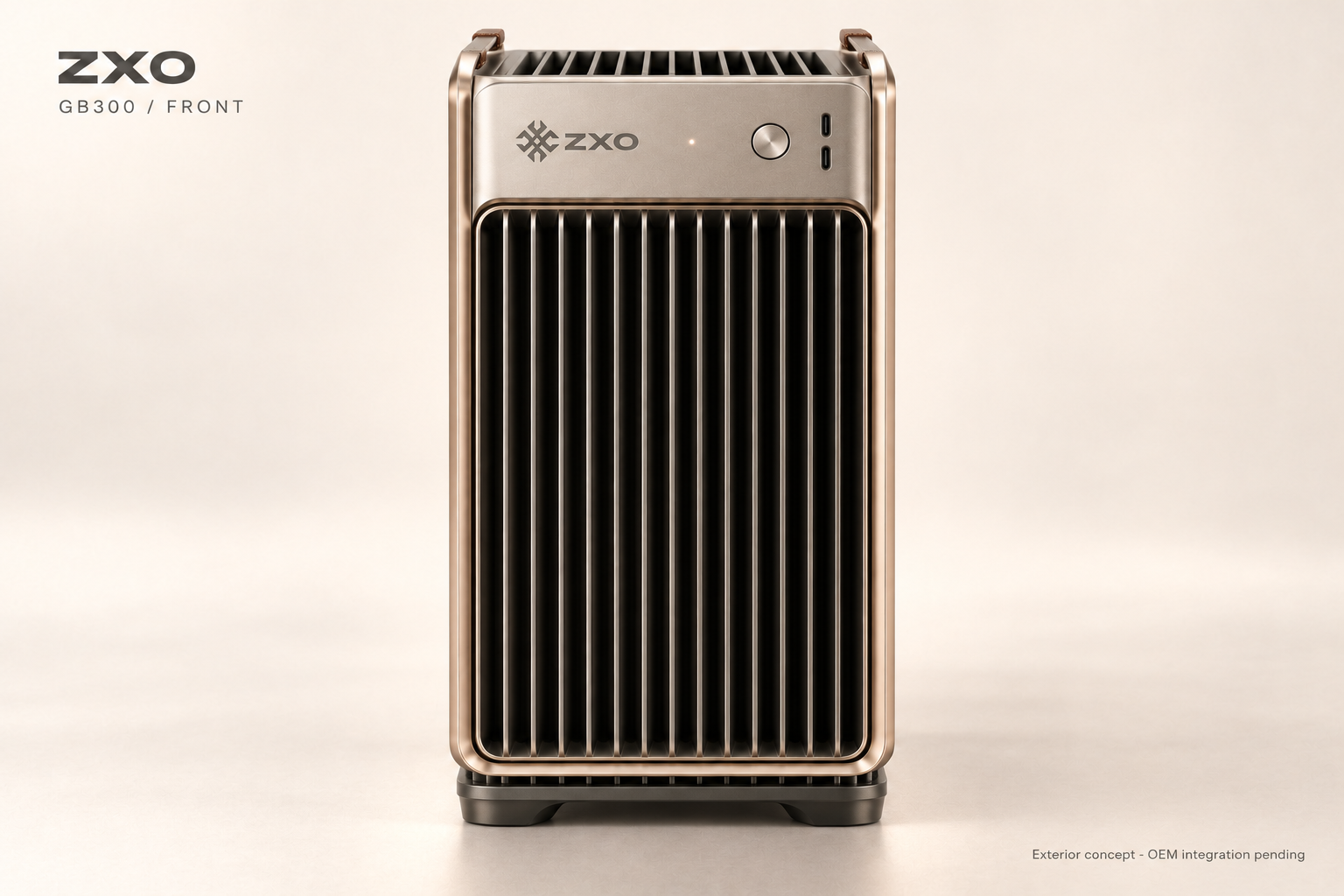
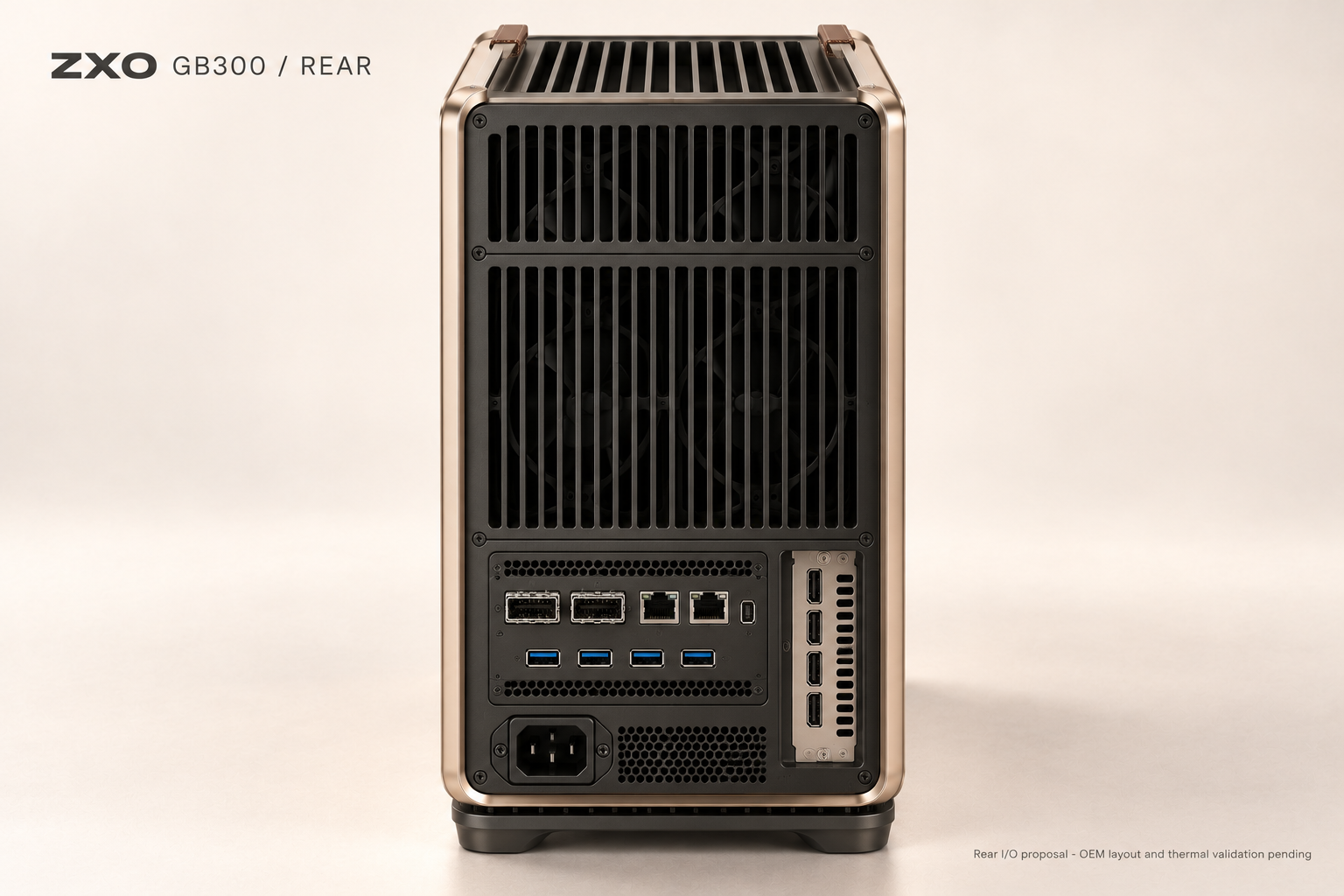
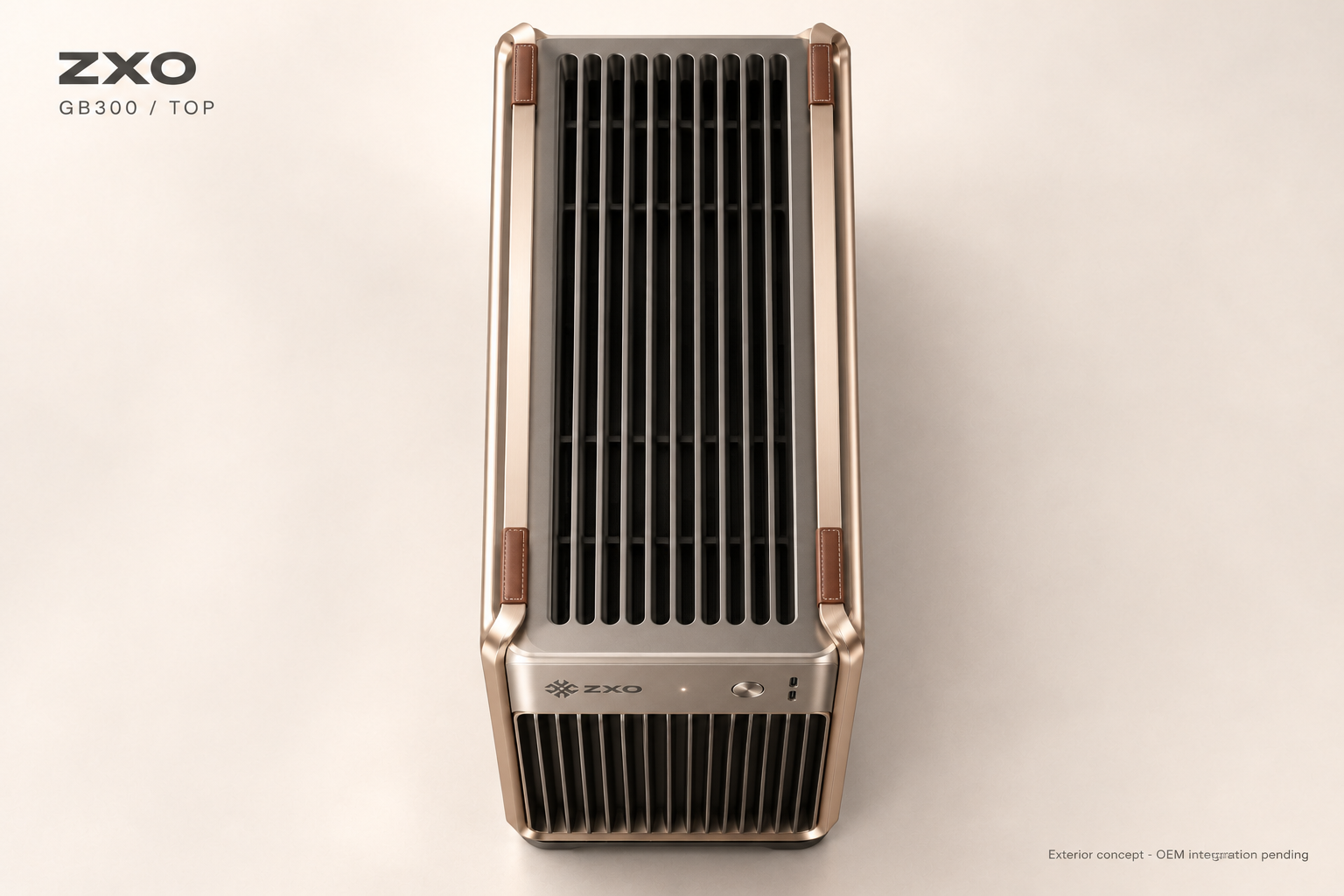
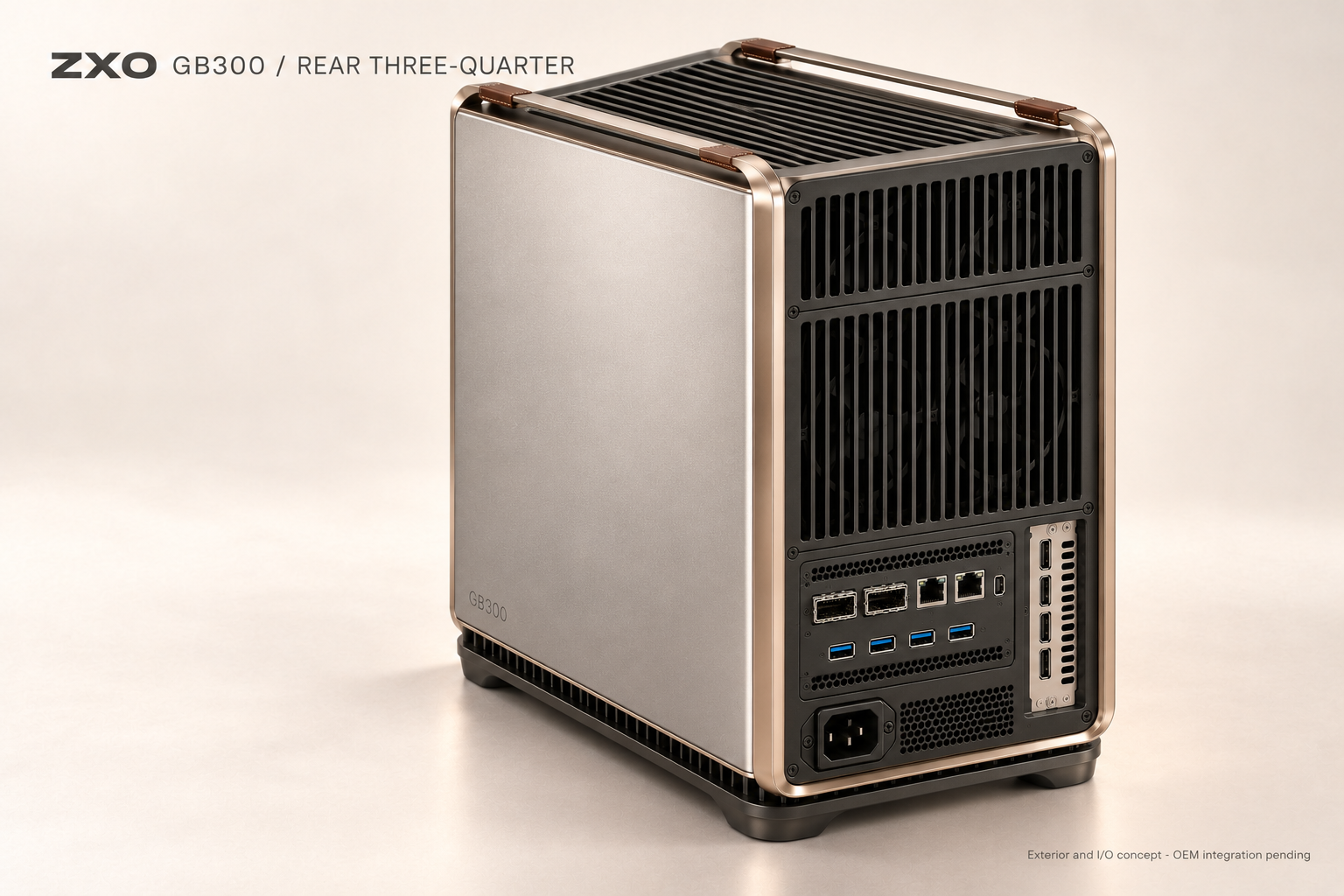
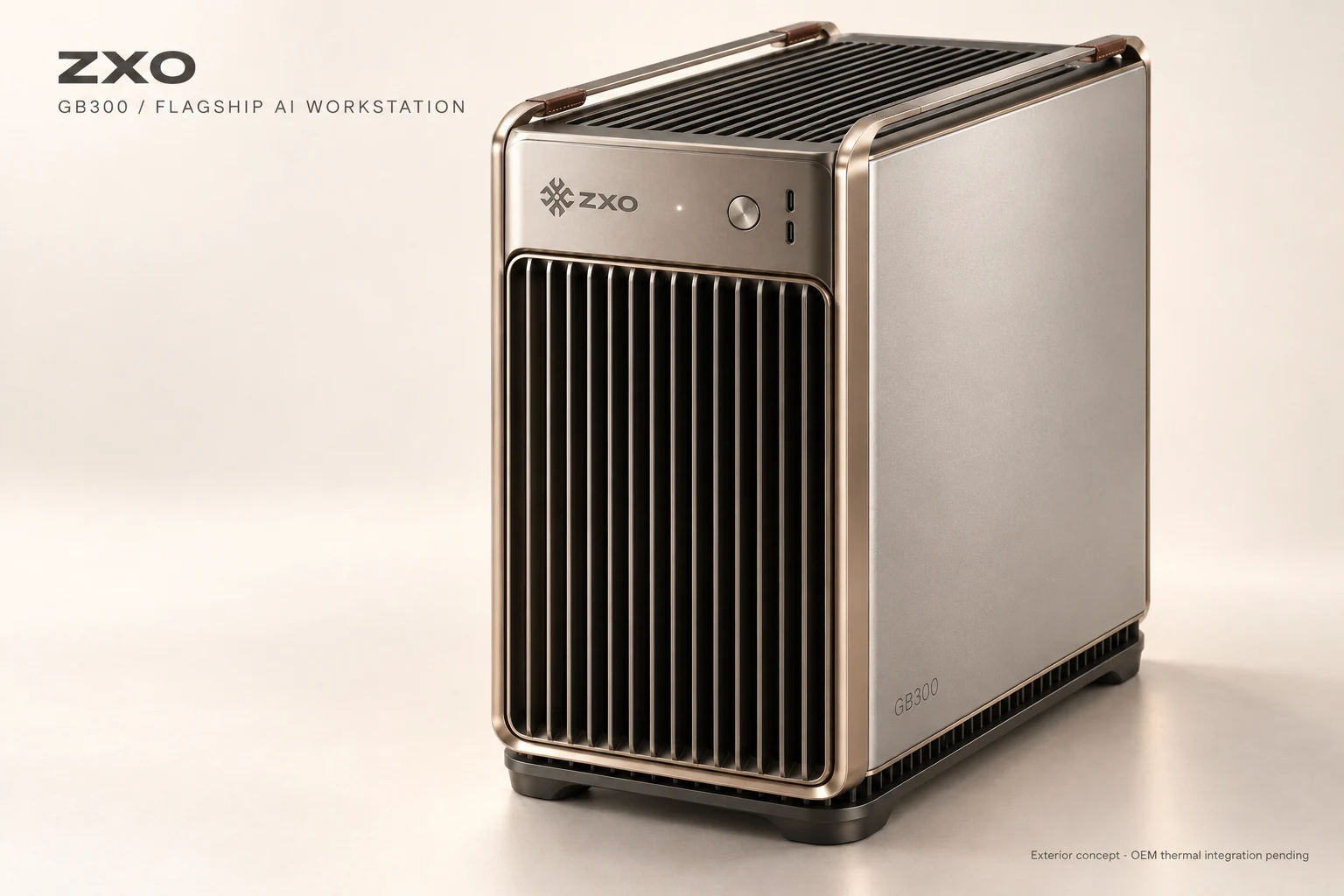
The front grille makes ventilation part of the identity. Broad openings, raised ground clearance and visible rear and top outlet areas give the thermal development brief a clear starting point.
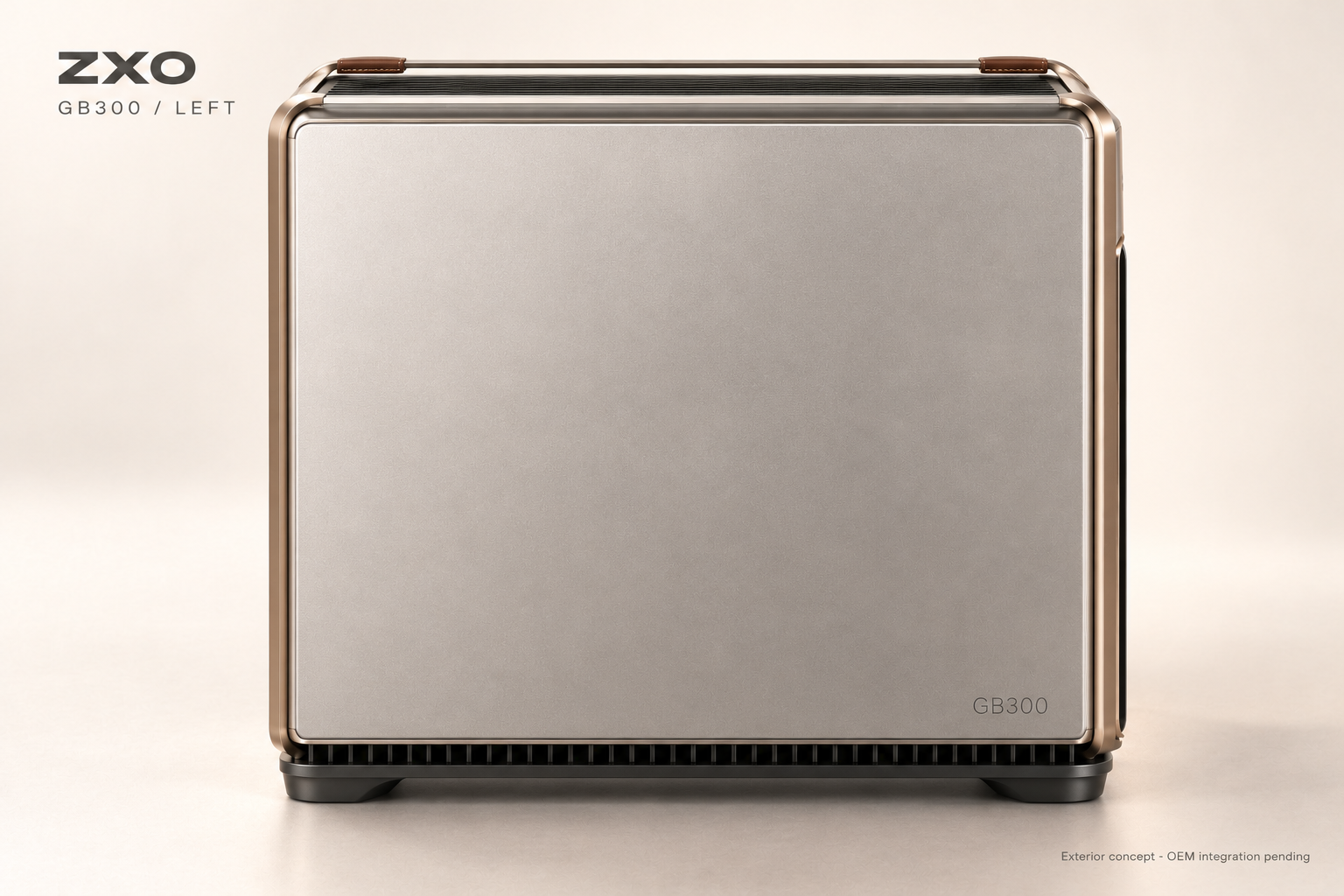
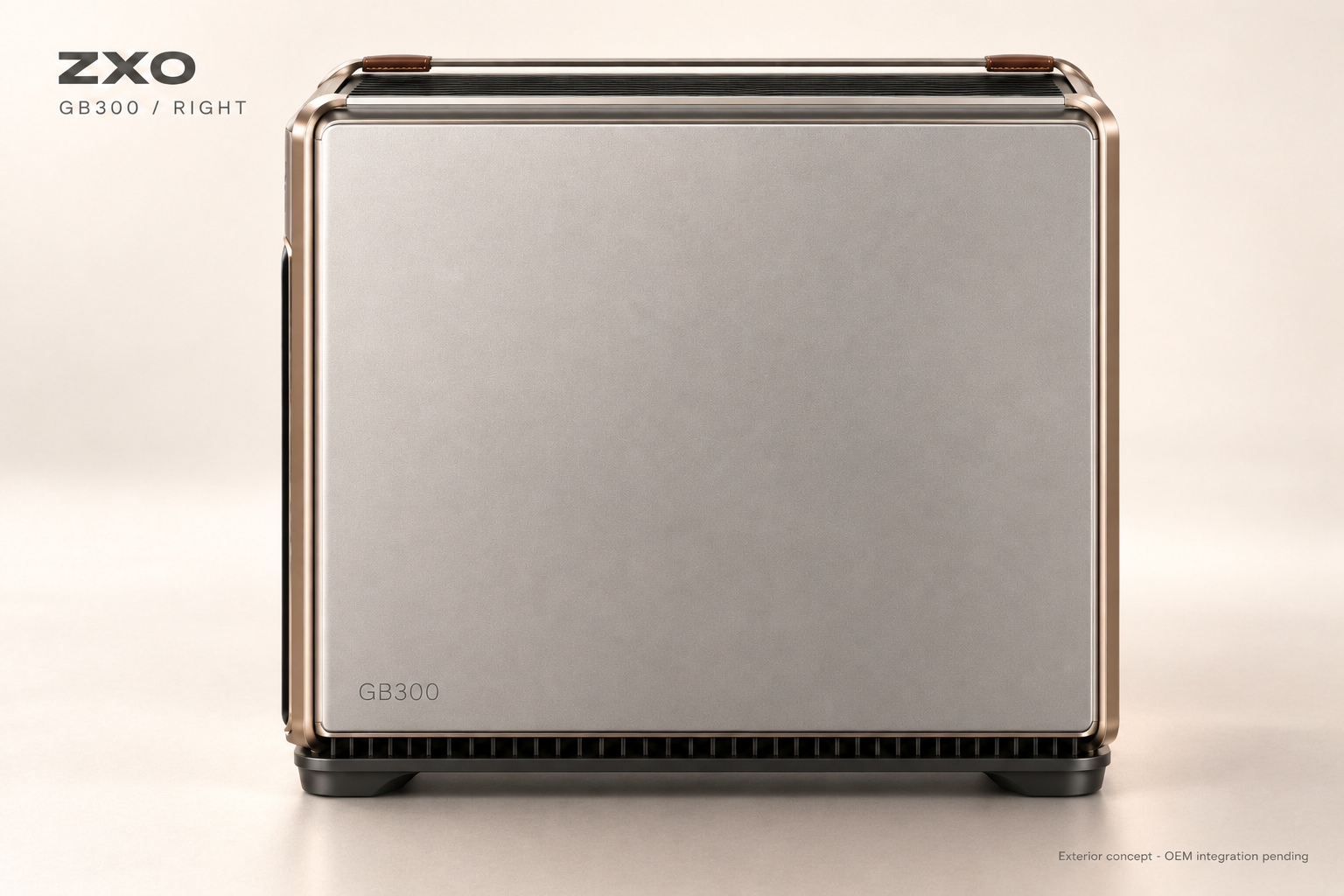
Satin titanium-silver aluminum is the proposed material direction, with slender champagne-colored metal rails and restrained grip accents. A small ZXO mark, a flush power button and simple status lighting keep the front focused.
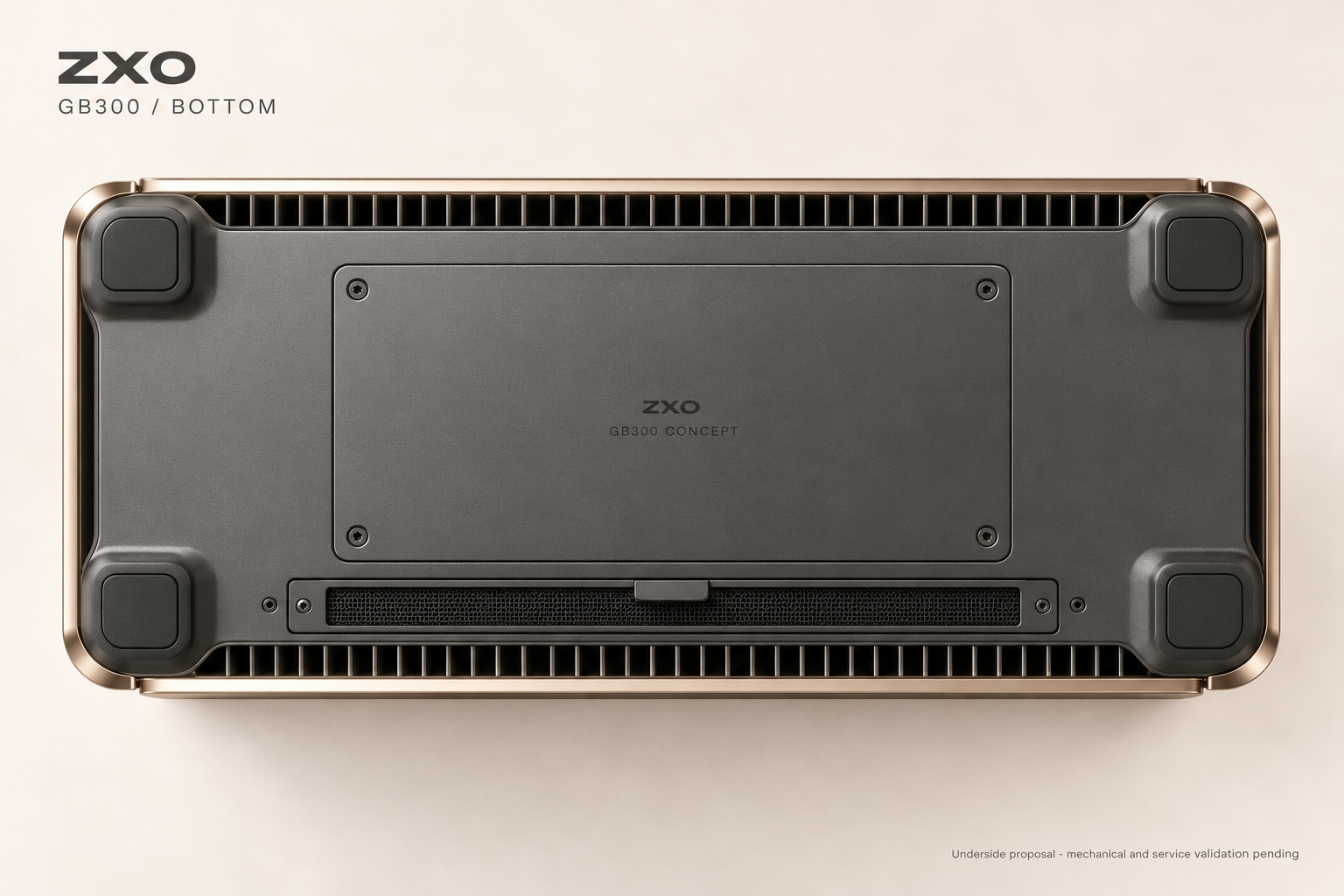
The final air path, cooling assembly, grip structure and service access must be developed around a supported OEM platform. The images show exterior intent rather than a completed thermal design.
Substantial ventilation areas are intended to support a practical air path. Intake resistance, component clearances and cooling controls will be assessed as one system.
Warm metal highlights, rounded transitions and a precise visual rhythm create a considered presence without decorative RGB lighting. Titanium-silver describes the proposed aluminum finish.
Panel access, dust maintenance, storage cooling and replaceable components belong in the engineering brief. Proposed grip accents are located away from ventilation surfaces.
02 / START WITH THE WORKLOAD
GB300 combines a Grace CPU and Blackwell Ultra GPU through NVIDIA NVLink-C2C. The proposed ZXO flagship adds a separate RTX PRO graphics target for applications that can use it. Configuration starts with the software and the job it needs to perform.
Develop inference services, evaluate compatible models and investigate supported fine-tuning workflows on a local platform. Actual capacity and response time depend on precision, quantization, context length, runtime overhead and the selected software.
An optional RTX PRO 6000 Blackwell Workstation Edition GPU is a proposed path for supported rendering, visualization and simulation applications. Application compatibility and the OEM power and cooling budget determine the final implementation.
Build compatible Ubuntu Arm64 and NVIDIA AI workflows with local storage for datasets, model checkpoints and project files. Networked servers or cloud resources can remain part of the process as the project grows.
UNDERSTAND THE MEMORY ARCHITECTURE
The GB300 desktop reference combines 252 GB of GPU HBM3e and 496 GB of CPU LPDDR5X into a coherent CPU/GPU memory architecture. The two memory types have different bandwidth characteristics; the total is not 748 GB of HBM3e.
The proposed RTX PRO expansion card has its own 96 GB of GDDR7 ECC memory. That memory remains separate and does not extend the GB300 coherent memory pool. How an application uses either GPU must be evaluated for that workload.
03 / PLATFORM AND FLAGSHIP TARGETS
Published platform references and proposed ZXO options serve different purposes. These tables identify the underlying architecture and the additions that still require platform sourcing, compatibility and system validation.
NVIDIA reference specifications describe the platform. They do not establish the final specification or measured performance of a ZXO system.
The GB300 platform and an additional graphics card must share a validated whole-system power and thermal budget. Simultaneous full-power operation is not assumed.
Official platform and component references
NVIDIA DGX Station GIGABYTE W775 platform Samsung 9100 PRO 8 TBDownload the ZXO GB300 target configuration Proposed hardware and validation notes / plain text
04 / A SUBSTANTIAL STORAGE BRIEF
The proposed four-drive configuration uses four 8 TB Samsung 9100 PRO NVMe SSDs. It is a capacity target for model libraries, datasets, checkpoints and project files, subject to confirmation of all four drives on the selected OEM platform.
Nominal raw capacity is the sum of the drives. It is not a promise of a single 32 TB usable volume. Filesystem overhead, reserved capacity and redundancy choices change the space available to applications.
Two 8 TB drives in a system RAID1 mirror plus two independent 8 TB data drives would provide approximately 24 TB of nominal logical capacity before formatting, if that arrangement is supported by the OEM software and storage configuration.
The 8 TB drive’s D5 thickness, slot clearance, heat sinks, thermal pads, qualified-drive list, power and firmware support all need checking. The target is not a validated ZXO maximum storage specification.
05 / EVERY ANGLE, CONSIDERED
Seven additional views describe the proposed silhouette, ventilation, interface areas and service surfaces. Select an image to open the full-resolution design artwork.
These are exterior concept images, not CAD projections or OEM mechanical drawings. Rear I/O, base service details, panel access and internal fit may change during development. Open the original hero artwork
BEFORE YOUR PROJECT TAKES SHAPE
ZXO GB300 is an exterior concept and proposed flagship configuration. OEM supply, supported components, mechanical integration, power, cooling, software and complete-system validation remain pending. Pricing, warranty and delivery terms have not been announced.
No. The GB300 coherent memory total is 748 GB, comprising 252 GB GPU HBM3e and 496 GB CPU LPDDR5X. The proposed RTX PRO card’s 96 GB is its own separate graphics memory. Applications need appropriate software support to use the two GPUs for different or coordinated tasks.
32 TB is the nominal raw capacity of four 8 TB drives. Usable capacity depends on formatting, reserved space, the storage layout and any redundancy. For example, two drives in a RAID1 system mirror plus two independent data drives would provide about 24 TB nominal logical capacity before formatting, if supported.
That requires OEM confirmation of the exact platform, power allocation, electrical supply and cooling assembly. NVIDIA’s reference DGX Station specification lists 1,600 W total system power and a 20 A circuit requirement. Adding an expansion card does not establish simultaneous full-power capability.
The proposed software direction is Ubuntu Arm64 with supported NVIDIA AI tools and compatible applications. GB300 uses an Arm CPU, so operating-system images, frameworks, drivers and application compatibility must be checked. Windows support and compatibility with any particular x86 application are not promised for the ZXO concept.
Share your models, applications and frameworks, expected memory and storage usage, visualization requirements, installation environment, available power, project quantity and timing. These details help define a supported configuration and the next development step.
SHAPE A PURPOSEFUL FLAGSHIP
Discuss a local AI project, professional visualization requirements or an OEM development collaboration for ZXO GB300.
PRODUCT CONCEPT BRIEF / PDF
Exterior concept, NVIDIA platform references and ZXO engineering targets in a one-page brief. Final configuration and availability require confirmation.